Compare British Museum guided tours: highlights tours, early-access visits and private guides. Find which suits your time, budget and group, and how to book.
British Museum Guided Tour: Which One to Book
The British Museum holds roughly eight million objects, and you'll see perhaps 0.01% of them on any single visit. That's not a flaw — it's the reason a British Museum guided tour exists in the first place. Walk in cold and you'll likely spend your first 40 minutes just figuring out which wing holds the Rosetta Stone, then another hour drifting past cases without much context. A decent guide fixes both problems: they get you to the right rooms fast and tell you why the objects matter.
General admission to the British Museum is free, which is unusual among London's major sights and part of why it draws over five million visitors a year. That free entry, though, means no built-in queue management — on a wet Saturday in school holidays, the main entrance line can run 20-30 minutes before you've seen a single exhibit. Guided tours and priority-entry tickets exist largely to solve that, plus the much harder problem of narrative: turning a warehouse of ancient objects into a story you'll actually remember by dinner.
Who Each Type of Tour Suits
Not every traveller needs the same thing from a museum visit, and the British Museum's tour market — spread across platforms like GetYourGuide, Viator and TripAdvisor — reflects that with genuinely different formats rather than just price tiers.
First-time visitors and short stays
If this is your only visit to London this trip, or you've got three hours between the Tower of London and a West End matinee, a fixed-departure highlights tour is the sensible default. These run typically 90 minutes to two hours, cover 12-20 major objects, and require zero planning beyond showing up at the meeting point. Solo travellers in particular do well here — you get the social buffer of a group without the obligation to make conversation, and the guide absorbs the logistics anxiety that solo museum-going sometimes brings. The trade-off is pace: you move when the group moves, and if you fall in love with the Sutton Hoo helmet, you don't get fifteen extra minutes with it.
Families, history buffs and small groups
Families with children under 10 are usually better served by a tour explicitly marketed as a British Museum tour for families — these build in interactive questions, shorter attention spans between stops, and often skip the more graphic Egyptian mummification detail that upsets younger kids. History buffs who already know their Assyrian reliefs from their Benin Bronzes tend to get more out of either a private guide (so they can go deep on their specific interest) or a themed tour focused on one civilisation or gallery, rather than a broad highlights sweep that will bore them by the halfway mark. Small groups of friends or extended family sit awkwardly in between — a private tour booked for the whole group often works out comparable per-person to a few individual tickets on a shared tour, so it's worth comparing both before deciding.
British Museum Tour Types Compared
Four broad categories cover almost everything bookable: scheduled highlights tours, early-access tours, private tours, and themed or specialist tours (Egypt-only, Greece-only, an architecture-and-history angle, and so on). They differ mainly in group size, flexibility, and what time of day you're moving through the galleries.
Highlights tours suit a first visit, while private and early-access tours trade a higher price for less crowding and more control over pace.
British Museum guided tour types compared by duration, pace and flexibility
| Tour Type | Typical Duration | Group Size | Flexibility | Best For |
|---|---|---|---|---|
| Highlights tour | 90 min – 2 hrs | Shared, often 10-25 | Low — fixed route and pace | First-time visitors, solo travelers |
| Early-access tour | 1.5 – 2.5 hrs | Shared, often 10-20 | Low-moderate | Crowd-avoiders, photographers, couples |
| Private tour | 2 – 3 hrs (adjustable) | 1-6, your own group | High — route and pace set by you | Families, specialists, small groups |
| Themed/specialist tour | 1.5 – 2 hrs | Shared, often 10-20 | Low | History buffs, repeat visitors |
Durations and group sizes are typical ranges; always check the specific listing for current details before booking.
Comparison table of tour categories
Below is how the main categories stack up on the factors that actually affect your decision — duration, pace, group size, and how much flexibility you're giving up.
Typical duration and what to expect
Highlights tours run on the shorter end, typically 90 minutes to just over two hours, and are built around a fixed route: Rosetta Stone, Egyptian sculpture gallery, the Parthenon (Elgin) marbles, Mesopotamian reliefs, and usually one or two detours depending on the guide. Early-access tours add 30-45 minutes of near-empty galleries before the museum opens to general admission, then often continue as a standard highlights walk once doors open to the public. Private tours have no fixed length — most operators offer two or three-hour blocks, but a guide booked privately will usually adjust on the spot if your group wants to linger. Themed tours sit close to highlights tours in length but narrow the content, so you'll see fewer rooms in similar time, with more depth per object.
Highlights Tours vs Early-Access vs Private
These three formats get compared most often because they cost roughly similar amounts for very different experiences, and the right pick depends less on budget than on what frustrates you most about crowded museums.
Worth seeing objects covered on a highlights tour
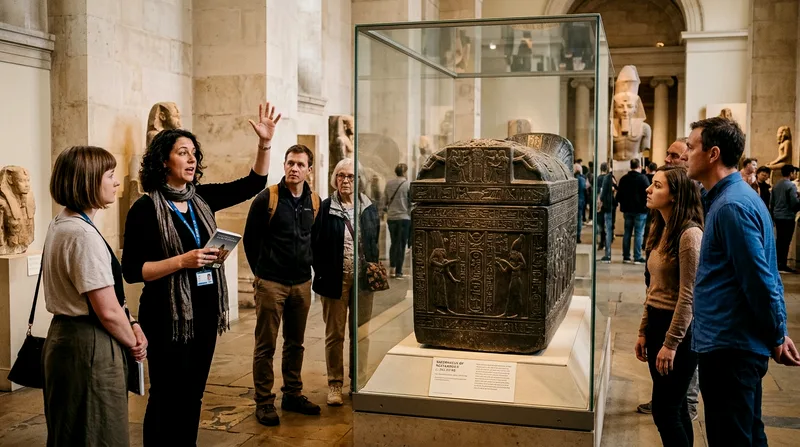
A standard British Museum highlights tour almost always includes the Rosetta Stone, the Egyptian mummies and sarcophagi in Rooms 62-63, the Parthenon sculptures in the Duveen Gallery, and usually the Sutton Hoo ship-burial treasures or the Lewis Chessmen, depending on the guide's focus. What varies more is the connecting narrative — a good guide links Egyptian, Greek and Mesopotamian rooms into one coherent story about how these objects left their countries of origin, which is also one of the museum's more contested topics and worth asking your guide about directly if you're interested; most are well briefed on it. A weaker tour just lists dates and dynasties, which you could get from the free Google Arts & Culture British Museum collection online for nothing.
Customisation and pace with a private guide
Private tours earn their higher price mainly through flexibility, not exclusivity — you're not getting secret access, you're getting a guide who will skip the Enlightenment Gallery entirely if your 8-year-old is fading, or spend 40 minutes on Assyrian lion hunts if that's what you came for. This matters most for mixed-ability families, travellers with mobility needs who require a slower pace and more seating stops, and anyone booking through a platform like WithLocals that pairs you with an independent local guide rather than a fixed-script operator. The downside is cost per person: for a solo traveller or couple, a private guide rarely makes financial sense compared with joining a shared highlights tour at a much lower rate. It makes far more sense once you're a group of four or more.
What to Look for When Booking
The listings on GetYourGuide, Viator and TripAdvisor can look near-identical at a glance — same photos of the Great Court, same "skip the line" language — so you need to read past the headline to compare what you're actually buying.
Inclusions, entry and group size
Since British Museum general admission is free, "priority entry" doesn't mean a paid ticket you'd otherwise lack — it means a reserved timed slot that bypasses the general queue, which matters more than people expect on peak days. Check whether the listed price includes this priority entry or assumes you'll queue separately and meet the guide inside; some budget highlights tours do the latter, which defeats half the point if you're short on time. Also check group size caps — anything over 25 people starts to feel like following a flag through a crowd rather than a guided experience, and you'll struggle to hear the guide in the busier galleries like the Egyptian sculpture hall.
Cancellation, accessibility and language options
Most reputable listings offer free cancellation up to 24 hours before the tour starts — treat anything stricter than that as a red flag unless the price is unusually low. For accessibility, the British Museum itself is largely step-free with lifts between floors, but confirm with the specific tour operator whether the route accommodates wheelchairs or pushchairs, since some private guides plan routes through narrower back galleries that aren't ideal. If English isn't your first language, both Viator and GetYourGuide let you filter by tour language — German, French, Spanish and Italian options exist for the main highlights route, though early-access and specialist tours have thinner language coverage, so book earlier if you need a non-English guide.
When to Book Your Tour
Timing affects both the quality of your visit and whether you can get the slot you want, and the two don't always point the same direction.
Best days and times to avoid crowds
Weekday mornings, particularly Tuesday through Thursday, are consistently the quietest time to be in the museum — school groups tend to cluster late morning on set days, and weekends draw the heaviest general footfall. Avoid the first two hours after opening on a Saturday if you can; that's when early-access tours have already finished and general admission crowds peak around the Rosetta Stone and Egyptian mummies. If you can only visit on a weekend, book an early-access tour specifically — it's the one format built around sidestepping that exact crush, and the Great Court genuinely looks and feels different with a tenth of the usual people in it.
How far ahead to reserve
Book highlights tours 3-7 days ahead for most weekdays; popular weekend slots and anything during UK school holidays (late July through August, plus Christmas and Easter breaks) can sell out one to two weeks in advance. Early-access and private tours have far fewer available slots per day, so reserve those two to three weeks out if your travel dates are fixed, especially in summer. If you're combining London with a wider European trip — say Paris, Amsterdam or Dublin — book the British Museum slot as soon as your London dates are confirmed rather than leaving it for a walk-up decision; unlike the Louvre or the Rijksmuseum, the free general admission here means there's no ticket scarcity forcing early booking, so people underestimate how fast guided slots fill.
Matching the Tour to Your Trip
If you're new to London and have half a day free, book a standard highlights tour and don't overthink it further. If you're travelling with young children or a group of four-plus, run the numbers on a private tour before dismissing it as extravagant — split four ways, it's often close to shared-tour pricing. If crowds genuinely bother you, early access is worth the earlier alarm. And if you can't get a guide slot that fits your schedule at all, Google Arts & Culture's British Museum collection is a reasonable fallback for pre-trip research, though it's no substitute for standing in front of the Parthenon marbles in person. Compare current listings and reviews on GetYourGuide, Viator or TripAdvisor before you book, and once you're done at the museum, Bloomsbury's garden squares and the nearby British Library make an easy, low-effort add-on to the same afternoon.
Frequently asked questions
What types of British Museum guided tours are available?
Four main categories: scheduled highlights tours covering the museum's best-known objects in a fixed route, early-access tours that start before public opening, private tours for individuals or small groups with a flexible itinerary, and themed tours focused on one collection, such as Egypt or Ancient Greece. All are bookable through major platforms like GetYourGuide, Viator and TripAdvisor, alongside independent local guides on sites like WithLocals.
How long does a British Museum guided tour take?
Most highlights and early-access tours run 90 minutes to two and a half hours. Private tours are typically booked in two or three-hour blocks but can run longer if your guide agrees beforehand. Given the museum's size, even a half-day private tour will only cover a fraction of the permanent collection.
Do guided tours include priority entry?
Many do, but not all — check the specific listing. Because general admission to the British Museum is free, priority entry means a reserved timed slot that avoids the general queue rather than a paid ticket you wouldn't otherwise need. On busy weekends this can save you 20-30 minutes.
Are British Museum guided tours worth it?
For a first visit, yes — the museum's scale makes self-guided wandering inefficient, and a guide's context on objects like the Rosetta Stone or Parthenon sculptures adds real value beyond the information plaques. If you've visited before and know exactly which galleries you want, a private tour or no guide at all may suit you better.
How far in advance should I book a guided tour?
Book standard highlights tours three to seven days ahead for weekdays, and one to two weeks ahead for weekends or UK school holiday periods. Early-access and private tours have fewer daily slots, so reserve those two to three weeks out if your dates are fixed, particularly in summer.