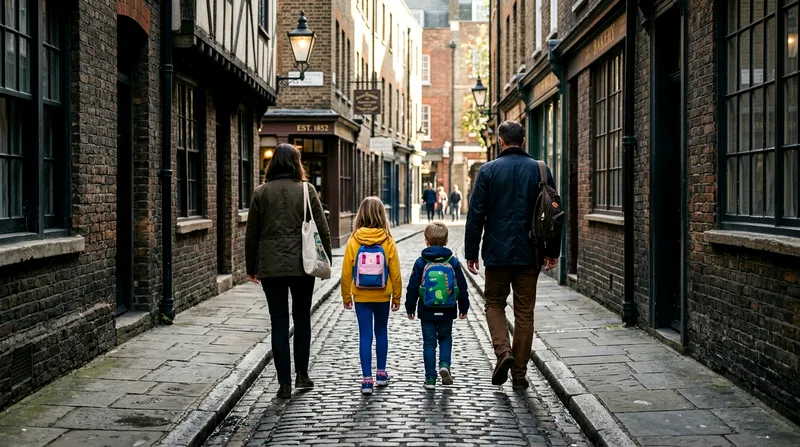
Plan London with kids in 3 days: a paced family itinerary with rest stops, playgrounds, pre-booked favourites, getting around advice and where to stay.
Who This 3-Day London Itinerary Suits
London with kids in 3 days is a realistic ask, but only if you accept upfront that you won't see everything — and that trying to will ruin the trip for everyone under four feet tall. This itinerary is built for families staying in or near central London, using public transport, with at least one child under 12. It assumes you'd rather see six things properly, with time to sit down and eat an ice cream, than tick off fifteen things while dragging an overtired six-year-old between Tube stations.
The route covers royal London and parks on day one, museums on day two, and the Tower plus the river on day three — a geographic logic that cuts down on backtracking. Compare this to trying to combine, say, the Tower of London with the British Museum and Greenwich in a single day: it's doable on paper, involves three Tube changes, and no parent I'd trust has done it with kids under 10 without a meltdown somewhere in the middle.
Toddlers versus older kids adjustments
With toddlers (roughly 1-4), cut each day's attraction list by about a third and lean harder into the parks — St James's Park and the playgrounds mentioned below will do more heavy lifting than any museum. Buggies are manageable on London's buses and most Tube stations with lifts, but stairs-only stations exist (check before you travel), so a lightweight stroller or a carrier as backup is worth it. For kids aged 5-12, the Natural History Museum's dinosaur gallery and the Tower of London's armour and ravens tend to land well, and they can handle longer walks between sights — 20-25 minutes on foot is usually fine, beyond that, use the Tube or a bus.
How the pacing works
Each day below follows a loose morning-afternoon-evening structure with one main "big" attraction and a deliberate rest stop — a park, a playground, or just a café with high chairs. The real trick with a 3 day London trip with children is treating 2pm to 4pm as recovery time, not another sightseeing block. Energy crashes hard after lunch, for kids and adults both. Build slack into the schedule rather than filling it, because London's queues, Tube delays and sheer distances will eat your buffer anyway.
Day 1: Royal London and Parks
Day one stays largely within walking distance of itself, which matters on a first day when everyone's still jet-lagged or just tired from travel.
Morning, afternoon and evening plan
Start at Buckingham Palace for the late-morning Changing of the Guard — it typically happens several days a week, so check the schedule before you go, as it doesn't run daily. Arrive at least 30 minutes early if you want the kids to actually see anything over the crowd. From there, walk 10 minutes into St James's Park, which has better views of the lake, pelicans, and far more shade and bench space than the Palace forecourt. After lunch — a picnic from one of the park's kiosks works well — head to the Household Cavalry Museum near Horse Guards, a compact, genuinely kid-friendly stop where children can see horses being groomed through a glass screen and try on a cavalry helmet; 45 minutes is plenty. Finish the afternoon at Trafalgar Square, which has fountains, street performers, and enough open space for kids to burn off energy before an early dinner nearby in Covent Garden.
Rest stop and playground break
Build in a 45-60 minute stop at the Diana Memorial Playground in Kensington Gardens if you're staying out that way, or simply sit by the St James's Park lake with a snack — don't underestimate how much a seated 20-minute break resets a tired toddler. If it's raining, swap the park time for the National Gallery on Trafalgar Square, which is free to enter and has family trails and activity backpacks you can borrow at the information desk.
Day 2: Museums and South Kensington
South Kensington is the single best cluster of family museums in London, and it's the one day of this itinerary I'd say is genuinely non-negotiable. Three major museums sit within a five-minute walk of each other, connected by an underground tunnel from the Tube station that avoids street crossings entirely — useful with a buggy or on a wet day.
Morning, afternoon and evening plan
Arrive at the Natural History Museum right at opening — queues build fast after 10am, especially during school holidays. The main hall's blue whale skeleton and the animatronic dinosaurs in the Dinosaurs gallery are the two things kids remember; budget two to two and a half hours and don't try to see the whole building, it's enormous. For lunch, the museum café works but is pricey and crowded; better to walk five minutes to one of the casual cafés on Exhibition Road. Spend the afternoon at the Science Museum next door — the Wonderlab gallery (small additional charge) is interactive and built for kids, and the ground floor space section is strong too. If energy's flagging, skip the Science Museum entirely and do Hyde Park's playgrounds and the Diana Memorial Fountain instead — it's a five-minute walk and completely free. Evening can be low-key: dinner in South Kensington or back near your hotel.
Rainy day swaps
This is already a strong wet-weather day since both main museums are indoors and free to enter (Wonderlab and some special exhibitions cost extra). If you want a full indoor alternative to the park elements, the V&A — the third museum in the South Kensington cluster — has a dedicated V&A Museum of Childhood-style family section and a covered courtyard with a shallow pool kids can wade in during warmer months.
Day 3: Tower, Thames and West End
Day three covers the most ground, so it's the day most worth pre-booking to avoid queue time eating your afternoon.
Morning, afternoon and evening plan
Get to the Tower of London for opening — this is one attraction where arriving early genuinely saves hours, since queues for the Crown Jewels can run long by midday. The Beefeater tours are free with admission and good for kids over about 6; younger ones may lose interest after 15 minutes, so it's fine to peel off and explore the ravens and battlements instead. Budget two and a half to three hours. From the Tower, walk across Tower Bridge (the glass floor walkway is a small extra ticket and a reliable hit with kids) and take a River Thames boat west toward Westminster — this is the one experience worth booking ahead, since sailing times and availability are limited and it saves a tired afternoon of Tube changes. The boat gives views of Tower Bridge, the Shard and St Paul's without anyone having to walk. Disembark near Westminster Abbey and Big Ben for photos (the Abbey interior is a long visit better suited to older kids or a childfree return trip), then head toward the West End for the evening.
Family-friendly evening entertainment
The West End has several long-running family shows suitable for kids from about age 6 upward — matinee performances exist for most and are considerably easier on bedtimes than evening shows, worth checking when you book. If a show feels like too much after a long day, Leicester Square and Covent Garden both have enough street performers and lit-up energy in the early evening to feel like an event without needing a ticket at all. Avoid booking a West End show as your only evening option on this trip — if day three runs long (it often does), you'll be cutting it fine on timing.
Getting Around and Where to Stay
Getting this logistics layer right matters more for a family trip to London 3 days long than for almost any other part of the planning, because wasted transit time is the thing that most reliably wrecks a tight schedule.
South Kensington offers the best museum access, while Bloomsbury and Earl's Court trade a few minutes' travel time for lower hotel costs.
London family-friendly areas compared for a 3-day itinerary with kids
| Area | Typical cost level | Tube access | Best for | Walk to parks |
|---|---|---|---|---|
| South Kensington | High | Excellent, step-free | Museum days | 5-10 min to Hyde Park |
| Bloomsbury | Mid | Good | British Museum, budget balance | 10 min to Russell Square gardens |
| Earl's Court | Mid-low | Good | Budget-conscious families | 15 min to parks |
| Paddington | Mid | Excellent, step-free | Easy airport access | 5 min to Hyde Park |
| Covent Garden/West End | High | Good, some stairs-only stations | Evening shows, central days | 15-20 min to St James's Park |
Typical cost levels and travel times only; check specific station step-free access before booking, as it varies station by station.
Tube, buses and strollers
London's buses are step-free and generally the easier option with a buggy — the Tube has lifts at many central stations but plenty of smaller ones are stairs-only, so check step-free access maps before committing to a route. An Oyster card or contactless bank card works across Tube, bus and most river boats, and kids under 11 travel free on the Tube and buses when accompanied by a paying adult, which is a meaningful saving over three days. Avoid the Tube entirely during weekday rush hour (roughly 8-9:30am and 5-6:30pm) with a buggy — it's genuinely unpleasant and sometimes unsafe to board a packed carriage with a pram.
Best family-friendly areas to base yourself
South Kensington is the strongest base for this itinerary — close to the museums, well connected by Tube, and full of family-suited cafés, though hotel prices there run high. Bloomsbury, near the British Museum, is a cheaper, quieter alternative with good Tube links and easy access to Covent Garden. Families on a tighter budget sometimes base themselves further out near Earl's Court or Paddington, both still Zone 1 with direct Tube access, saving noticeably versus Kensington or Mayfair. Whatever you pick, prioritize proximity to a Tube station with a lift over saving ten minutes' walk to a sight — the lift matters far more over three days than the extra steps.
Optional Bookable Experiences for Kids
A few experiences across this itinerary benefit from pre-booking, not because they sell out hours in advance, but because walking up cold means queuing time you don't have on a tightly paced family trip.
What to pre-book in advance
Book Tower of London tickets online before you go — it's cheaper than paying at the gate and lets you skip the ticket-office queue, though you'll still queue for security and the Crown Jewels. The Thames river boat on day three is worth reserving a specific sailing time for, since walk-up tickets are usually available but timed slots guarantee you're not standing on a pier with cranky kids. If a West End matinee is part of your plan, book that first of everything — family-friendly shows have limited matinee performances and seats near the front (better for small kids) go early. Wonderlab at the Science Museum also benefits from a pre-booked timed slot. Compare current prices and time slots for each before you book, since these change seasonally.
Money-saving tips
The Natural History Museum, Science Museum, V&A and National Gallery are all free to enter — only special exhibitions and add-ons like Wonderlab carry a charge, so you can fill two of three days with free world-class museums. Kids under 11 ride London transport free with an adult, and under-16s often get reduced or free entry at paid attractions like the Tower — bring proof of age. If you're comparing this trip to a similar family break in Paris or Amsterdam, London's free museum policy is a real financial advantage — the Louvre and the Rijksmuseum both charge standard adult admission with no equivalent blanket free policy for major national collections.
Frequently asked questions
Is 3 days in London enough with kids?
Yes, for a first visit — three days lets you cover royal London, the South Kensington museums, and the Tower plus the river without constant rushing. You won't fit in Greenwich, Harry Potter studio tours, or a day trip to Windsor; save those for a return visit or extend to 5 days if they're priorities.
How do you pace a 3-day London trip with children?
Cap each day at one major attraction plus one park or playground, and treat the early afternoon as recovery time rather than another sightseeing slot. Start big attractions at opening to dodge both queues and the post-lunch energy crash, and keep evenings low-key on at least two of the three nights.
What are the best museums for kids in London?
The Natural History Museum (dinosaurs, the blue whale skeleton) and the Science Museum (Wonderlab, interactive galleries) are the strongest picks, both free to enter with optional paid extras. The V&A's family areas and the Household Cavalry Museum near Horse Guards are good second choices for a shorter, quieter visit.
How do you get around London with kids and a stroller?
Buses are step-free throughout and generally easier than the Tube with a buggy; check step-free access maps before relying on specific Tube stations, since many central ones are stairs-only. Avoid weekday rush hours (roughly 8-9:30am and 5-6:30pm) with a pram, and budget extra time for lifts, which can be slow or crowded at busy stations.
Which area of London is best for families to stay in?
South Kensington is ideal if museums are your priority, with excellent step-free Tube access and everything walkable. Bloomsbury and Earl's Court offer a cheaper alternative with only slightly longer travel times, while Paddington works well if you're also managing airport transfers.