Compare Regent's Canal boat tours from Little Venice to Camden. See how waterbuses and narrowboats differ, what to check before booking, and when to go.
Which Canal Tour Suits You?
A Regent's Canal boat tour is not one product — it is a route served by several different kinds of boat, each with its own pace, comfort level and price point. Before you compare operators on GetYourGuide or Visit London's listings, decide what you actually want from the hour or so on the water. Do you want commentary and a fixed schedule, or the freedom to pootle along at your own speed? Do you need a toilet on board, step-free access, or buggy space? These questions matter more than which company's logo is on the hull.
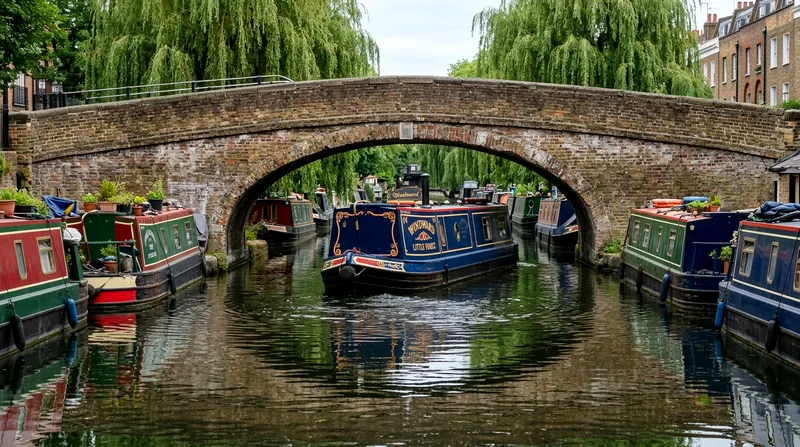
The core route runs between Little Venice, a junction of canals near Paddington where houseboats line the banks, and Camden Lock, the start of Camden Market's sprawl of stalls and food stands. Most tours cover this roughly 50-minute stretch one way, gliding past Regent's Park, the London Zoo aviary, and a run of Victorian-era wharves and private moorings that you simply cannot see from the street. It's a different London — slower, greener, and far less crowded than the South Bank or a Thames river cruise.
I'd avoid booking the very cheapest round-trip ticket without reading what "round trip" actually means — some are a straight there-and-back on the same boat with minimal time ashore, which can feel repetitive if you've already seen Camden Lock on the way out.
Families, couples and first-time visitors
For a first visit to London with children in tow, the London Waterbus Company's scheduled service between Little Venice and Camden is the simplest choice — it runs on a fixed timetable, has an open-air viewing section, and the crew usually points out landmarks like the zoo aviary without turning it into a formal guided commentary. Couples looking for something quieter and less child-focused might prefer a narrowboat trip, which moves slower and often carries fewer passengers, giving more room to actually talk rather than shout over an engine. Families should budget the full round trip as a half-day outing once you factor in Camden Market afterwards — rushing it defeats the purpose.
Photographers and accessibility needs
Photographers get the best light and least crowded decks on an early departure, ideally before 11am, when the water is stiller and fewer waterbuses are queuing at the Camden Lock mooring. Open-top waterbuses give unobstructed shots of the aviary and the canal-side gardens; narrowboats sit lower and can restrict your angle. If accessibility is a concern, don't assume step-free boarding — many narrowboats have a narrow gangplank and a drop down into the cabin, which is difficult for wheelchair users or anyone with limited mobility. Contact the operator directly before booking to confirm ramp access at both Little Venice and Camden, since towpath conditions vary by water level and season.
Regent's Canal Route at a Glance
Regent's Canal runs for just over 13 kilometres from Paddington Basin to the Thames at Limehouse, but the stretch tourists actually book is the roughly 4.5km section between Little Venice and Camden Lock. That's the scenic core: tree-covered towpaths, grand stuccoed houses backing onto the water, and the contrast of Regent's Park's open green space against London Zoo's riverside aviary, designed by Lord Snowdon and still visible from the water. Boats typically take 45 to 60 minutes one way at a gentle, non-rushed pace — this isn't a speedboat, and nobody's trying to break a record.
Little Venice to Camden Lock highlights
Little Venice itself is worth arriving early for — it's a genuine canal junction with painted houseboats, a small café scene, and none of the market crush you'll find later at Camden. As you head east, you pass under Maida Hill tunnel, skirt the edge of Regent's Park, catch the aviary, then wind past Pirate Castle, a community boating centre near Camden that's been teaching canoeing and narrowboating to local kids since the 1960s. Camden Lock itself marks the end of the ride and the start of the market — expect it to be busy, especially on weekends, with towpath congestion near the lock gates themselves.
Alternative starting points such as King's Cross
Little Venice to Camden gets all the attention, but King's Cross is a legitimate alternative starting point, particularly if you're already near the station or visiting Coal Drops Yard. From King's Cross, Regent's Canal continues east toward Islington through the Islington Tunnel, a different and less touristed stretch with fewer boat operators running fixed trips — self-drive or private hire tends to dominate here. It's also where the London Canal Museum sits, in a former Victorian ice warehouse, and it's a sensible stop before or after a shorter canal walk if you'd rather not commit to a full boat trip.
Waterbus vs Narrowboat vs Self-Drive
The three main categories differ in capacity, flexibility and cost, and picking the wrong one for your group is the most common booking mistake. Waterbuses, like those run by the London Waterbus Company, operate on a timetable with multiple daily departures and carry upwards of 40 to 50 passengers — reliable, affordable, but not private. Narrowboat tours are traditional, slimmer, slower vessels, often with a guide giving informal commentary; groups are smaller, usually under 12, and the experience feels more like a canal trip than public transport. Self-drive electric boats, offered by operators like GoBoats in other parts of London's waterways, let small groups pilot their own vessel for an hour or two — no license required for most small electric boats, but you do get a safety briefing and should expect a learning curve steering around other canal traffic.
A scheduled waterbus is the cheapest and most convenient way to cover Little Venice to Camden, while self-drive and private hire trade cost for flexibility.
Regent's Canal boat tour categories compared: waterbus, narrowboat, private hire and self-drive
| Tour Type | Typical Duration | Group Size | Best For | Flexibility |
|---|---|---|---|---|
| Waterbus | 45-60 min one way | 40-50 passengers | First-timers, families, budget trips | Fixed timetable |
| Narrowboat (shared) | 60-90 min | Up to 12 | Couples, photographers, slower pace | Some stops possible |
| Private narrowboat hire | 1-3 hours | Exclusive to your group | Special occasions, small groups | High |
| Self-drive electric boat | 1-2 hours | 4-8 per boat | Independent groups, active travelers | Full route choice within hire zone |
Typical figures based on commonly published tour formats; exact durations and capacities vary by operator, so confirm before booking.
Comparison table of tour categories
See the table below for how these stack up on cost, duration, group size and who each suits best. None of these figures are fixed — always check current prices and schedules on the booking platform before confirming.
Private hire vs shared trips
Shared trips — waterbus or group narrowboat — are cheaper per person and suit solo travelers, couples and families who don't mind sharing the deck with strangers. Private hire, usually a narrowboat booked exclusively for your group, costs considerably more overall but makes sense for a special occasion, a small tour group, or anyone wanting full control over timing and stops. I wouldn't bother with private hire just for a standard sightseeing run between Little Venice and Camden — the view is the same whoever else is on board, and the premium mostly buys you privacy and flexibility rather than a better route.
What to Check Before Booking
Booking platforms like GetYourGuide list multiple Regent's Canal options side by side, which is useful but also means descriptions can be thin on detail. Read past the headline price and check what's actually included before you commit — this is where most disappointment comes from, not the trip itself.
Inclusions, commentary and boat type
Confirm whether the ticket is one-way or round trip, whether commentary is live or a recorded audio track, and whether the boat is open-top or enclosed. Open-top waterbuses are better for views and photos but offer no shelter if it rains — bring a layer even in summer, since the canal corridor is shaded and noticeably cooler than the street. Check also whether the price includes entry to anything else; a few tours bundle a discounted Camden Market voucher or London Canal Museum entry, but most don't, and you shouldn't assume it.
Group size, cancellation and weather policy
Ask about maximum group size if you're booking a shared narrowboat — a boat built for 12 can feel cramped with luggage or a buggy. Check the cancellation policy carefully: many canal operators run rain-or-shine since boats have partial cover, but will cancel in high wind or very low water levels, which does happen in dry summers. Refund policies vary, and "free cancellation up to 24 hours" is common but not universal. Wear flat, closed shoes — the towpath and boarding points can be uneven or slippery, especially near the locks.
When to Book and Best Season
Regent's Canal boat tours run broadly from spring through autumn, with a reduced or paused winter schedule for some smaller operators — don't assume year-round service the way you might with a Thames clipper. If you're visiting London between November and February, check directly with the operator rather than relying on a general listing, since several narrowboat companies cut services back to weekends only or close entirely until March.
Peak weekends vs winter operations
Weekends from May to September are the busiest window, particularly Saturday afternoons when Camden Market draws its biggest crowds and towpaths near the lock get genuinely congested. If you can, go on a weekday morning — you'll get a calmer ride, shorter queues at the mooring, and better photos without other boats crossing your frame constantly. Winter sailings, where they exist, tend to be shorter and colder but also quieter; layer up, since the open sections of a waterbus offer no heating.
Combining with Camden Market or London Canal Museum
Most people book the boat trip as one half of a day that includes Camden Market for food stalls and shopping, or the London Canal Museum near King's Cross for canal history and the old ice wells beneath the building. Doing both in one day is tight — allow at least three hours total if you want the boat, a proper look at the market, and transit time back to central London. A sensible structure is: arrive Little Venice mid-morning, take the boat to Camden, eat and browse the market, then take the Northern line back rather than reversing the boat trip.
Frequently asked questions
How long is the boat trip from Little Venice to Camden?
Most waterbus and narrowboat services take 45 to 60 minutes one way to cover the roughly 4.5km stretch of Regent's Canal between Little Venice and Camden Lock. Private hire or self-drive trips can run longer since you set your own pace and stops. Add waiting time at each end for boarding, which is usually 10 to 15 minutes before scheduled departure.
Do canal boats run in winter?
Some do, but service is reduced. Larger scheduled waterbus operators often keep a limited winter timetable, usually weekends only, while smaller narrowboat companies may pause entirely from November to March. Always check directly with the specific operator before planning a winter visit around a canal trip.
What is the difference between a canal boat and a narrowboat?
"Canal boat" is the general term for any vessel on the canal, including waterbuses. A narrowboat specifically refers to the traditional long, slim boats — originally built to fit 19th-century canal locks — that are now used for both tours and residential moorings along Regent's Canal. Narrowboat tours tend to be smaller-group and slower-paced than standard waterbus services.
Is Little Venice worth visiting?
Yes, even without taking a boat. It's a quiet junction of canals with houseboats, cafés and a small towpath market on some weekends, and it feels distinctly different from central London's pace. If you're short on time, 30 to 45 minutes walking the waterside before or after a boat trip is enough to get the feel of it.
Are there other starting points besides Little Venice?
Yes — King's Cross is the main alternative, giving access to a different, less touristed eastern stretch of Regent's Canal toward Islington. It suits travelers already near King's Cross station or visiting the London Canal Museum, though fewer fixed-schedule tours operate from there compared with Little Venice.