Compare the best London escape room types by theme, difficulty and English-language ease. Find the right escape game for groups, couples and first-timers.
Which Escape Room Suits Your Group?
London has somewhere north of 150 escape room venues scattered across the city, which is exactly the problem. Search "london escape room" and you'll get options ranging from a 45-minute office-based puzzle box to a 90-minute immersive theatre experience with actors. Before you even look at themes, work out who's playing and how many of you there are — that narrows the field faster than any amount of browsing reviews.
Most rooms are built for 2–6 players, with a sweet spot around 4–5 for pacing. Go below that and some puzzle-heavy rooms feel like too much work for too few hands; go above it and immersive or horror rooms with tight physical sets can get congested, with people standing around waiting for a turn. A few venues, including some Breakin' Escape Rooms locations, offer linked rooms or larger-capacity games specifically for groups of 8–12, which is worth asking about directly rather than assuming a standard room scales up.
The other variable is who's squeamish. A couple on a first date night and a stag party booking a gore-heavy horror room have completely different tolerance levels, and most venues are upfront in their room descriptions about jump scares, actor contact and whether rooms get genuinely dark. Read that paragraph properly — it's usually more useful than the star rating.
Couples and Date Nights
For two people, skip anything billed as "extreme difficulty" or requiring 6+ players for the puzzle logic to work — you'll spend half the hour stuck on a lock that needs a third person's perspective. Mystery and classic detective-style rooms tend to suit pairs best because the puzzle density is calibrated for fewer hands, and the pacing rewards close teamwork rather than divide-and-conquer tactics. Secret Studio and similar venues often flag which rooms work well for two on their booking pages — check that before paying. Horror rooms can be a fun shared-adrenaline date too, but only if both of you actually enjoy being startled; it's a genuinely bad night out if one person spends the session with their eyes shut near the exit.
Friends, Families and Corporate Groups
Groups of 5–8 get the most out of immersive, multi-room experiences — something like The Crystal Maze Experience, which spreads puzzles across several themed zones and genuinely needs multiple people working different problems simultaneously. For corporate team-building, Game Over London and Escape London both run rooms explicitly marketed at work groups, with some offering debrief facilitation afterward, which private players don't usually need or want to pay for. Families with children under 12 should look specifically for "family-friendly" or junior difficulty tags — standard rooms assume adult reading speed and reasoning, and a straightforward 60-minute room can feel endless for a bored eight-year-old.
London Escape Room Types Compared
Escape rooms aren't one product. The four broad categories — classic puzzle rooms, immersive/theatrical rooms, horror rooms and mystery/detective rooms — differ enough in format that picking the wrong one is the main reason groups come out disappointed, not bad luck with a venue.
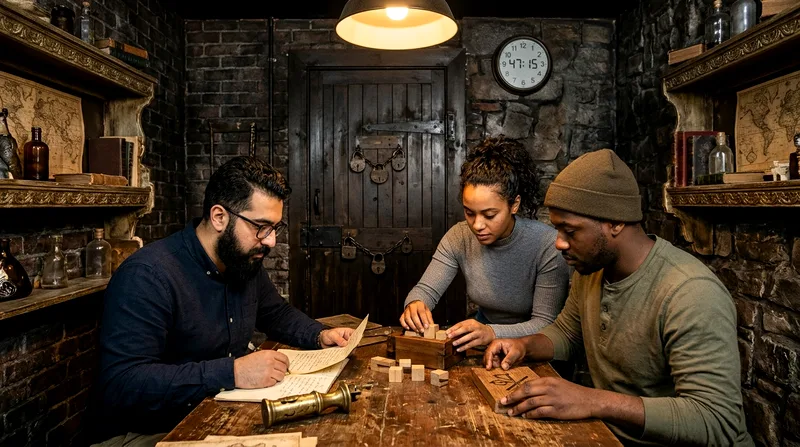
Classic rooms are the original format: a locked room, physical locks, hidden compartments, a 60-minute clock. clueQuest, one of London's longer-running operators, still runs rooms in this style, and they're a reliable choice if you want a pure puzzle experience without theatrical overhead. Immersive rooms add actors, set design and sometimes multi-room journeys — The Crystal Maze Experience is the clearest London example, built more like a theme park attraction than a single locked door. Horror rooms lean on atmosphere, jump scares and sometimes live actors who touch or chase players; these are the ones to avoid if anyone in your group has genuine anxiety issues, not just mild nervousness. Mystery rooms sit closer to a detective story, with narrative clues, red herrings and a "whodunit" structure that rewards reading and deduction over physical searching.
None of these is objectively better — they suit different moods. A rainy Tuesday afternoon with a mixed-age family calls for a classic or mystery room. A stag or hen do wants horror or immersive. Corporate groups usually do best with classic or immersive rooms, since horror can alienate colleagues who didn't sign up to be chased around a basement.
Classic and mystery rooms suit smaller or mixed-age groups, while immersive and horror rooms demand larger groups or a higher tolerance for intensity.
London escape room types compared by duration, group size and intensity
| Room Type | Typical Duration | Group Size | Intensity | Best For |
|---|---|---|---|---|
| Classic puzzle | 60 min | 2-6 players | Low-moderate | First-timers, mixed ages |
| Immersive/theatrical | 60-90 min | 4-10 players | Moderate-high | Groups, special occasions |
| Horror | 60 min | 2-6 players | High | Thrill-seekers, adults only |
| Mystery/detective | 60-75 min | 2-6 players | Low-moderate | Couples, puzzle lovers |
Durations and capacities vary by venue; always confirm specifics and current prices when booking.
Comparison Table: Classic, Immersive, Horror, Mystery
Use the table below as a quick filter before you start reading individual room descriptions — it will save you from booking a horror room for a family with young children, which happens more often than operators would like.
Escape Rooms by Theme and Difficulty
Difficulty ratings in London escape rooms aren't standardized across venues the way, say, ski slope ratings are — a "hard" room at one venue might be an "intermediate" elsewhere. Still, most operators publish an approximate success rate (the percentage of teams who escape within the time limit), and that's a far more useful number than the difficulty label itself. Anything above a 40–50% success rate is genuinely approachable for first-timers; below 20% means expect to fail, and some seasoned players treat that as half the appeal.
Beginner-Friendly Rooms
If you've never done an escape room, start with a classic-style room with a published success rate above 40%, a 60-minute limit and no actor interaction. Several Escape Plan rooms and clueQuest's entry-level games are built with first-timers in mind, with a games master monitoring progress and offering hints via screen or walkie-talkie if you stall. Take the hints — new players often refuse them out of pride and burn 20 minutes on one lock, which ruins the pacing for everyone else in the room.
Challenging Rooms for Experienced Players
Experienced teams — people who've done a dozen or more rooms — should look for venues that publish low success rates or explicitly market "expert" tiers. These rooms often strip back hint availability, run tighter 45–60 minute windows and layer puzzles so one wrong deduction cascades into a dead end. Some immersive venues also run sequel or "part two" rooms only available after completing an earlier game, which is worth asking about if you want a genuine step up rather than just a harder reskin of the same locks-and-keys format.
Best Areas for Escape Games in London
Where you book matters more than visitors expect, mostly because London's transport layout means a room 20 minutes from your hotel can eat an hour round trip in zone changes and walking.
Central and East London
Whitechapel has become something of an escape room cluster, with several horror-leaning venues taking advantage of cheaper East London rents and the area's genuine Jack the Ripper history for atmospheric theming. It's well served by the London Overground and District/Hammersmith & City lines, so it's an easy add-on if you're already exploring Shoreditch or Brick Lane. Central venues near Covent Garden or Soho tend to be classic or mystery-style rooms, priced slightly higher but walkable from most Zone 1 hotels — convenient if you're combining it with a West End show the same evening.
West and North London
Shepherd's Bush has a couple of well-regarded venues worth building an afternoon around, particularly if you're already near Westfield London for shopping — Game Over London has run rooms in this part of the city aimed at groups and corporate bookings. Islington, further north, suits an evening combination with its restaurant and pub scene; Breakin' Escape Rooms and smaller independents have operated in the area, and it pairs naturally with a night out along Upper Street. Compared with Paris or Amsterdam, where escape rooms cluster more tightly in one or two central districts, London's scene is genuinely spread across zones — expect to pick a room near where you're already spending the day rather than making a special trip across the city.
What to Check Before Booking
Booking an escape game in London is straightforward, but the details that go wrong are predictable: wrong group size, no refund on cancellation, and language assumptions that trip up non-native English speakers.
Inclusions, Group Size and Cancellation
Confirm the minimum and maximum players before paying — some venues charge a flat room rate regardless of numbers, others charge per head, and turning up with two extra friends can mean they're turned away at the door. Cancellation policies vary widely: some operators offer free rescheduling up to 24–48 hours ahead, others take a non-refundable deposit at booking. If your trip dates are flexible, check the cancellation terms before confirming, not after. Always compare current prices and reviews on the venue's own booking page before confirming, since availability and room rotation change often.
Accessibility and English-Language Support
For European travelers worried about language, most London rooms run entirely in English with no subtitled alternative, though game masters are typically happy to clarify clues verbally if your group is mixed-level. A handful of central venues, aware of the international tourist market, offer briefings in simplified English or printed clue sheets — worth asking by email beforehand rather than assuming. On accessibility, many classic rooms are step-free and wheelchair accessible, but immersive and horror rooms with maze-like sets, low lighting or crawl spaces often aren't — check the venue's accessibility statement directly rather than guessing from photos.
When to Book Your Escape Room
Weekend evening slots, particularly Friday and Saturday 6–9pm, sell out fastest in London's escape room scene, especially at well-known venues like clueQuest or The Crystal Maze Experience where capacity is naturally capped by the immersive set design. If you're visiting London on a fixed schedule, book at least a week ahead for weekend slots; weekday afternoons are far easier to get same-day or with 24 hours' notice. Compare this to Edinburgh or Dublin, where the smaller escape room scenes mean even popular venues rarely sell out more than a day or two in advance — London's higher tourist volume changes the calculus. If you're combining an escape room with another booked activity, like a river cruise or a West End matinee, build in at least 90 minutes of slack either side, since briefings and photo sessions after the game often run 15–20 minutes past the advertised slot.
Frequently asked questions
What are the best escape rooms in London?
There's no single "best" — it depends on group size and taste. clueQuest and Escape Plan are solid for classic puzzle fans, The Crystal Maze Experience suits groups wanting a bigger immersive day out, and Secret Studio and Escape London both run well-regarded mystery and horror rooms. Check recent reviews on each venue's own site before booking, since quality varies room to room even within one operator.
How difficult are London escape rooms?
Difficulty varies enormously by venue and room, not just by theme. Many operators publish a success rate — rooms above 40% are beginner-friendly, while anything under 20% should be expected to end in failure even for decent teams. There's no city-wide standard, so always check the specific room's stated difficulty rather than assuming based on category.
Which escape rooms are best for groups?
Immersive, multi-room experiences like The Crystal Maze Experience work best for groups of 6–10, since the puzzles are spread across zones to keep everyone busy. For corporate groups, Game Over London and Escape London both offer rooms designed with team-building and debrief sessions in mind.
What age can children do escape rooms?
Most London venues set a minimum age around 8–10 for standard rooms, with some family or junior-rated rooms accepting younger children if accompanied by an adult. Horror rooms are typically restricted to 16 or 18 and up due to jump scares and dark, enclosed sets — always check the venue's age policy directly, as it's enforced at the door.
What escape room themes are available in London?
London covers most major themes: classic heist and prison-break rooms, horror sets based on asylums or haunted houses, mystery/detective narratives, and large-scale immersive worlds like The Crystal Maze Experience. Whitechapel has a notable concentration of horror-themed venues, while Islington and Shepherd's Bush lean more toward classic and group-friendly formats.