Compare London street art tours: guided Shoreditch and Brick Lane walks, private vs group, and spray-paint workshops. Find the right fit before booking.
Which Street Art Tour Suits You?
East London's walls don't sit still. A mural that was the star attraction on Hanbury Street last spring might be painted over by autumn, replaced by something newer, louder, or by a local council's grey primer. That churn is the whole point of a London street art tour — it's the one sightseeing activity in the city where the "exhibit" genuinely changes month to month, sometimes week to week. Walking through Shoreditch alone with a map app will show you plenty of color, but you'll miss who painted what, why a piece appeared where it did, and which half-hidden stencil down an alley off Brick Lane is actually a Banksy-era survivor versus a newer homage.
A guide fixes that. Local street art guides — often working artists themselves — know which walls are "legal" rotating canvases and which pieces are genuinely old enough to be historic by street art standards (a few years, in this world). They'll point out a Space Invader mosaic bolted above a doorway that you'd walk past twenty times without noticing, or explain why ROA's animal murals keep reappearing around Hackney Road.
If you want to skip the group entirely, a private street art tour in London gives you the same expertise on your own schedule — useful for families managing nap times, or couples who don't want to match pace with eight strangers. It costs more per person but you control the route, the pace, and how long you linger over photos.
First-timers, photographers and art fans
If this is your first visit to Shoreditch, go guided rather than self-directed — the area's grid of backstreets (Rivington Street, Redchurch Street, the Village Underground wall) isn't intuitive, and a lot of the best work sits in alleys you'd never turn down alone. Photographers specifically should ask in advance whether the tour times itself for soft morning light on Brick Lane's east-facing walls, since midday sun flattens the colour on a lot of the larger pieces. Serious art fans who already know the Banksy back-catalogue might find a standard group walk too introductory — look instead for a guide with an arts or curatorial background, often advertised on operator listings as "local expert" or "artist-led."
Families, groups and solo travelers
Families with children under ten generally do better with a shorter workshop than a two-hour walking tour — the spray-painting itself holds kids' attention far longer than looking at walls does. Solo travelers are well served by group walks: they're sociable without being forced, and most run small enough (often eight to fifteen people) that you can ask questions directly. Larger groups or work outings should look at private bookings, since a fixed group tour with six other families mixed in rarely gives you the flexibility a work social needs.
Street Art Tour Types Compared
Three formats dominate the East London street art market: the guided walking tour, the private tour, and the hands-on spray-paint workshop. They solve different problems. A walking tour is about context and coverage — you'll cross Shoreditch, Hoxton and Brick Lane in two to three hours and see a genuine cross-section of the scene. A workshop trades ground covered for skill gained — you'll stay largely in one studio or yard and leave with a canvas you made yourself. Private tours are really a pricing and flexibility variant on the guided walk, not a separate experience.
None of these formats should be confused with a bus tour or a self-guided app route, both of which exist but miss the point somewhat — street art rewards slow walking and a guide who can read a wall's layers, not a recorded commentary heard through a window.
Guided walks suit first-time sightseeing, while workshops suit anyone who wants to leave with a painted canvas rather than just photos.
London street art tour formats compared: duration, group size and hands-on level
| Format | Typical duration | Group size | Hands-on level | Best for |
|---|---|---|---|---|
| Group walking tour | 2-3 hours | 8-20 people | None (viewing only) | First-timers, solo travelers, budget-conscious visitors |
| Private walking tour | 2-3 hours | 1-8 people (your group) | None (viewing only) | Families, couples, flexible schedules |
| Spray-paint workshop | 1.5-3 hours | 6-15 people | High — you paint a canvas | Kids, hands-on travelers, rainy-day plans |
| Combined walk + workshop | 3-4 hours | 8-15 people | Medium | Those wanting both context and a souvenir piece |
| Self-guided route | Flexible, 1-3 hours | Solo or any size | None | Repeat visitors, tight budgets, confident navigators |
Durations and group sizes are typical ranges based on how these tours are commonly structured; confirm specifics with the operator before booking.
Group walk vs private tour
A standard group walk is the default for good reason: it's cheaper per head, runs on a fixed schedule so you can book without coordinating anyone else's calendar, and the shared-group dynamic often produces better questions than you'd think to ask alone. The downside is pace — you move at the group's speed, and if someone's slow or endlessly photographing one wall, everyone waits. A private tour removes that friction entirely and lets you add requests (more Banksy history, less general graffiti culture, extra stops in Hackney Wick) but expect to pay roughly two to four times the per-person group rate, since you're covering the guide's full time regardless of headcount.
Guided walk vs spray-paint workshop
The honest comparison here isn't quality, it's what you want to leave with. A guided walk leaves you with photos and knowledge — names like ROA and Space Invader will mean something afterward. A spray-paint workshop in Shoreditch leaves you with a physical canvas and sore shoulders, but you'll likely only see a handful of outdoor murals on the way in, if any. Combination tours exist — a shorter walk followed by a workshop session — and they're a reasonable middle ground, though the walking portion is usually compressed to under an hour.
Guided Walks in Shoreditch and Brick Lane
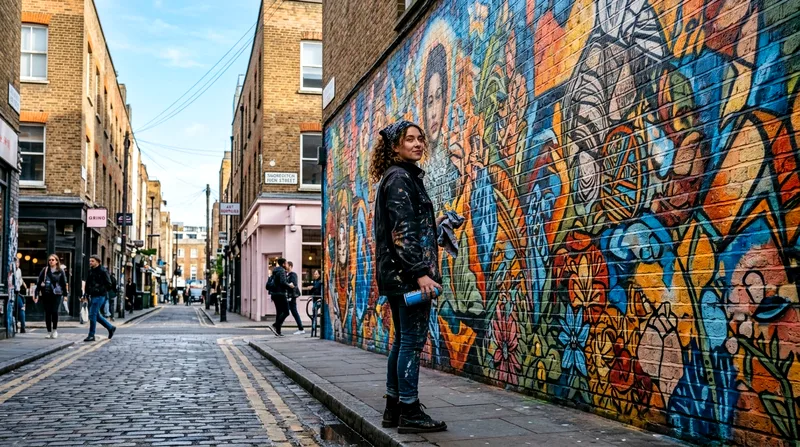
Most Shoreditch street art tours follow a loop covering Brick Lane, Hanbury Street, Redchurch Street, and the Village Underground area near Great Eastern Street, sometimes extending into Hoxton Square. That's a manageable distance on foot — under two miles — but the route zigzags down narrow backstreets rather than moving in a straight line, which is exactly why a guide earns their fee here. Brick Lane itself is the densest concentration: the walls get repainted so often that pieces genuinely stack on top of each other, giving the area its distinctive layered, half-peeling texture.
Compare this to how street art tourism works elsewhere and the East London version stands out. In Paris, street art tours tend to cluster around Belleville and the 13th arrondissement, more spread out and less commercially saturated. Rome's street art scene, centred on Ostiense and Tor Marancia, leans toward large single-artist murals rather than Shoreditch's dense overlapping style. Amsterdam has pockets of street art but nothing with the tour infrastructure London has built around Brick Lane — East London has arguably turned graffiti into its most consistent sightseeing product of any major European city.
Artists and works you may see
Don't book a tour promising a guaranteed Banksy — most of his original East London pieces have been removed, painted over, or protected behind perspex in ways that strip their street context, and operators who guarantee a sighting are overselling. What you can reliably expect is work from artists who still actively repaint the area: ROA's large-scale animals (a recurring rabbit or heron is common around Hackney Road), Space Invader's small tiled mosaics tucked onto brick corners and lamp posts, and a rotating cast of paste-up artists and newer names your guide will introduce on the day. Treat any specific-piece promise with skepticism — the honest operators describe themes and artists, not guaranteed works.
Graffiti Workshops and Hands-On Experiences
A graffiti workshop in London swaps walking for doing. Sessions run in a studio, yard, or occasionally a legal outdoor wall, and they're built around teaching basic spray-can technique — layering, stencil work, can control — rather than theory. Expect a session length of roughly ninety minutes to three hours, which includes a safety briefing, a demonstration, and practice time before you start your own piece. Most include all materials: cans, stencils if used, protective gear, and a canvas or board to take home.
This suits a different traveller than the walking tour does. If you've got restless teenagers, a wet-weather contingency day, or you just want a genuinely different souvenir from London beyond a postcard, a workshop delivers. It's a weaker choice if you're short on time and want to see as much of the city's actual street art as possible — you'll spend most of the session in one location, not moving through Shoreditch.
What a typical session includes
Expect an instructor demonstration first — can distance, pressure control, and how paint behaves differently on canvas versus brick. Then a practice round on scrap material before you start your actual piece, usually guided by a stencil or simple design so beginners don't feel lost. Groups are kept fairly small, often under fifteen, because instructors need to walk around checking technique. Protective gear (apron, gloves, sometimes a mask) is standard; ask specifically whether it's included if you have respiratory sensitivity to paint fumes, since ventilation varies a lot between studio spaces.
Legal walls vs illegal graffiti
Worth understanding before you book: most of what you'll see on a Shoreditch walk is legal, commissioned, or at minimum tolerated by property owners — councils and landlords in the area have largely embraced the murals as a draw rather than a nuisance. Workshops operate strictly on legal walls or private canvases; nobody is handing beginners a can and pointing them at someone's shopfront. If a tour description implies anything otherwise, that's a red flag rather than an edgy selling point.
What to Check Before Booking
Street art tours are sold through the usual channels — Viator, TripAdvisor listings, and operators' own sites — and the review volume on those platforms is actually useful here, since a tour with ninety recent five-star reviews mentioning "the guide was an artist himself" tells you more than any marketing copy. Read the three or four most recent reviews specifically, not just the overall score, because guides change and route quality can shift.
Inclusions, group size and accessibility
Confirm whether the price includes materials (for workshops), a map or route sheet, and whether tips are expected separately — East London tour guides commonly work partly on gratuities. Check group size caps; a listing that doesn't state a maximum group size is worth avoiding, since oversized groups make it hard to hear the guide on a street with traffic noise. Brick Lane's pavements are uneven and some backstreets have no dropped kerbs, so anyone using a wheelchair or pushing a stroller should email the operator directly to ask about the specific route rather than assuming.
Cancellation and weather policies
Outdoor walking tours generally run rain or shine, light rain included — bring a compact umbrella rather than expecting cancellation. Workshops held outdoors are more weather-dependent and should state a rescheduling policy for heavy rain. Always check the cancellation window before paying in full; many operators allow free cancellation up to 24 hours ahead, but some non-refundable discounted rates exist, so read that line rather than assuming standard terms apply.
When to Book Your Tour
Street art tours run year-round, unlike a lot of London's outdoor sightseeing, because the appeal survives grey skies reasonably well — murals photograph fine under flat light, sometimes better than in harsh sun. That said, booking patterns are seasonal. Spring and summer weekends sell out group walks faster, partly because they overlap with Brick Lane's Sunday market crowds, which also makes the streets more congested for photography.
Best seasons, days and times of day
Weekday mornings are the quietest time to walk Shoreditch and Brick Lane — fewer market stalls blocking sightlines, softer light, and smaller tour groups competing for the same wall. Sunday mixes well with the Brick Lane market itself if you don't mind crowds, since several tours intentionally time around it. Winter offers genuinely good value and thinner crowds, though check sunset times if you're booking a late-afternoon slot, since East London's lighting on the walls drops fast once the sun's down by mid-afternoon. Compare this to booking a walking tour in Dublin or Edinburgh, where weather is a bigger determining factor — London's indoor-adjacent workshop option gives you a reliable backup that those cities' outdoor-only equivalents don't always offer.
Frequently asked questions
What are the best street art tours in London?
The strongest options are small-group guided walks through Shoreditch and Brick Lane led by someone with an arts background, plus hands-on spray-paint workshops for a different kind of souvenir. Check recent reviews on Viator or TripAdvisor for mentions of the specific guide, not just the operator, since guide quality varies more than route quality.
How long does a street art walking tour take?
Most run two to three hours, covering roughly one to two miles through Shoreditch, Brick Lane, and often Hoxton. Combination tours that add a short workshop segment run closer to three to four hours total.
What is included in a spray painting workshop?
Typically all materials — spray cans, stencils, protective gear, and a canvas or board — plus instruction from someone experienced in street art technique. Sessions run roughly ninety minutes to three hours; confirm gear and ventilation details if you have paint-fume sensitivity.
Can you take a self-guided street art tour in London?
Yes — Brick Lane and Shoreditch are walkable without a guide, and several free online maps mark known mural locations. You'll move faster and spend nothing, but you'll miss the artist context and may not find smaller pieces, like Space Invader mosaics, tucked onto less obvious walls.
Where is the best street art in Shoreditch and Brick Lane?
Brick Lane itself, Hanbury Street, Redchurch Street, and the area around Village Underground on Great Eastern Street consistently have the densest, most frequently refreshed work. Treat any list of "worth seeing" pieces skeptically, though — walls get repainted often enough that specific murals can't be guaranteed to still be there.