Compare London bike tours by route, traffic exposure, distance and fitness level, with e-bike options and what to check before you book.
Which London Bike Tour Suits You?
Seeing Big Ben, Tower Bridge and St Paul's Cathedral from a saddle gives you a pace that walking tours can't match and buses certainly don't — you cover three or four miles in the time it takes to queue for one attraction. London bike tours range from gentle two-hour loops of Hyde Park to half-day rides that cross the Thames twice and thread through the City's narrow lanes. The right choice depends less on how fit you are and more on how much traffic you're willing to tolerate.
Londoners cycle on busy roads every day, but tour operators generally don't route visitors through the worst of it. Most guided bike tours in London stick to parks, cycle superhighways, and quieter back streets, saving the bigger roads for short, necessary crossings near Westminster or the South Bank. That said, no route through central London is entirely traffic-free, and anyone expecting a car-free ride like Amsterdam's cycle paths will be disappointed. London's infrastructure has improved — the Cycle Superhighways along the Embankment are genuinely good — but it's not Dutch-level separation everywhere.
If you've cycled a handful of times in the last year and can ride in a straight line while looking around, you'll manage any standard tour fine. If you haven't been on a bike since school, say so when booking — most operators ask about experience level, and a good guide will adjust the route or put nervous riders at the front of the group, just behind them.
First-time and nervous cyclists
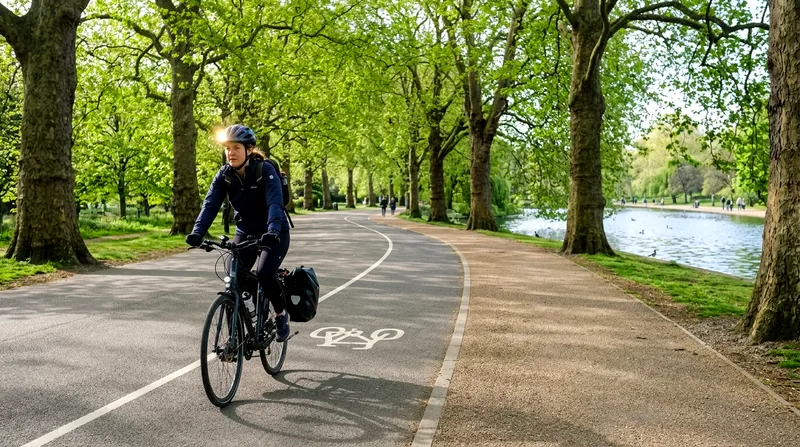
Choose a Royal Parks-focused tour. These stay almost entirely on car-free paths through Hyde Park, Kensington Gardens, and sometimes Regent's Park, with only brief, guide-led road crossings to link them. Group sizes are typically kept to 10–15 riders, and pace is slow enough that you're rarely out of breath. Avoid anything billed as a "City highlights ride" or "Thames crossing tour" as your first experience — these involve more junctions, bus lanes, and roundabout navigation near landmarks like Westminster Bridge, which can rattle someone who hasn't ridden in traffic before. Ask specifically about road exposure when you book; a vague answer is a warning sign.
Families and fitter riders
Family bike tours in London usually cap at a gentler pace and shorter distance — often under 6 miles — with stops built in for photos and snack breaks. Check the minimum age and wheel size requirements before booking; most operators require children to confidently ride a two-wheeler unassisted, and tag-alongs or child seats are rarely available, so a nervous 6-year-old may struggle. Fitter riders and couples without children can handle the longer city-and-riverside combination routes, which run 3–4 hours and cover more ground, including Tower Bridge, the South Bank, and sometimes a loop past the London Eye.
London Bike Tour Types Compared
Broadly, London cycling tours fall into five categories: group tours, private tours, standard-bike tours, e-bike tours, and themed routes (Royal Parks, City, or riverside). They overlap — you can usually book a private e-bike tour of the Royal Parks, for instance — but understanding the base categories helps you filter options on booking platforms like TripAdvisor or GoCity before comparing specific listings.
Group tours are the default and the cheapest per person. You'll ride with strangers, typically 8 to 20 of them, following one or two guides who narrate as you go and stop at fixed points for photos and history. The trade-off is pace: you move at the speed of the slowest rider, and stops are timed rather than flexible. Private tours flip that — you set the pace, choose (within reason) which landmarks to linger at, and get a guide's full attention, but you pay a premium for it, generally several times the per-person group rate.
Group vs private tours
Group tours suit solo travelers and couples who want a sociable, affordable introduction to London by bike — you'll likely chat with other travelers during stops, which some people enjoy and others find distracting. Private tours make sense for families who want to control timing around a child's energy levels, for senior travelers who may need more frequent rest stops without holding up a group, or for anyone short on time who wants the guide to prioritise specific landmarks — say, skipping Hyde Park entirely to spend longer around Westminster and the Thames. Platforms like GuruWalk list some free or pay-what-you-want walking equivalents, but genuine free bike tours are rare; expect to pay for both bike hire and guiding on any cycling option.
Standard bike vs e-bike
Standard hybrid or city bikes are the default on most tours and are perfectly adequate for London's mostly flat center — there's a mild climb near Primrose Hill and through parts of Greenwich, but nothing in the typical tour routes that demands serious leg strength. E-bikes add pedal-assist motors, useful if you're covering more than 10 miles, riding in summer heat, or simply want to arrive at each stop without being out of breath before the guide starts talking. They typically cost noticeably more to hire for the day and are heavier and slightly less maneuverable at low speed, which matters more in tight City-center turns than in open parkland.
Royal Parks vs City and Riverside Routes
This is the real decision point, more than group size or bike type. Royal Parks routes — through Hyde Park, Kensington Gardens, and often Green Park — are near-entirely on dedicated paths, flat, and scenic, but they skip most of the landmarks people actually come to London to photograph. City and riverside routes deliver Tower Bridge, St Paul's Cathedral, the London Eye and the South Bank, but involve real traffic: taxis, buses, delivery vans, and the occasional aggressive cyclist courier.
Compared with cycling in Amsterdam or Copenhagen, London's riverside routes feel more exposed, closer to cycling in Rome or Barcelona's old town, where you're sharing lanes rather than gliding on separated infrastructure. It's manageable with a competent guide who knows the junctions, but it's not relaxing in the way a Hyde Park loop is.
Royal Parks routes offer the calmest ride, while City and riverside tours trade some traffic exposure for landmark-dense routes past Tower Bridge and Westminster.
London bike tour categories compared by traffic, distance and fitness level
| Tour Category | Traffic Exposure | Typical Distance | Duration | Fitness Level | Best For |
|---|---|---|---|---|---|
| Royal Parks | Low | 4-6 miles | 2-2.5 hours | Easy | First-timers, nervous cyclists, families |
| City Highlights | Moderate-High | 6-9 miles | 2.5-3.5 hours | Moderate | Confident riders wanting landmarks |
| Riverside/Thames | Moderate | 8-12 miles | 3-4 hours | Moderate | Couples, fitter solo travelers |
| E-Bike Tour | Varies by route | 8-15 miles | 2.5-4 hours | Easy-Moderate | Seniors, less confident riders, hot weather |
| Private Tour | Varies by route | Flexible | Flexible | Flexible | Families, limited-time travelers |
Figures are typical ranges based on commonly offered tour formats; exact distance, duration and route vary by operator, so confirm details before booking.
Traffic exposure by route
Royal Parks routes: minimal traffic, mostly shared paths with pedestrians and other cyclists. City routes: moderate to high, with several light-controlled crossings near Westminster and the City, plus narrow lanes around St Paul's. Riverside/Thames-path routes: moderate, generally better than central City streets since much of the path runs alongside the river away from vehicles, though you'll cross traffic to reach Tower Bridge and the Southbank access points. If traffic anxiety is your main concern, ask explicitly what percentage of the route is on dedicated paths versus shared roads — a specific answer is a good sign the operator knows the route well.
Distance and landmarks covered
Royal Parks tours typically run 4–6 miles over two to two and a half hours. City and riverside combination tours run longer, often 8–12 miles over three to four hours, covering Westminster, Big Ben, the London Eye, Tower Bridge, and sections of the Thames path. A handful of extended tours stretch into Greenwich or Richmond Park for a half-day commitment closer to five hours — worth it only if you're already cycling-fit and want distance over density of sights.
E-Bike Tours for Less Confident Riders
An e-bike tour in London is worth considering if you're a senior traveler, recovering from injury, or simply someone who hasn't ridden regularly in years but wants to cover more ground than walking allows. The pedal-assist motor flattens out the psychological barrier of starting from a standstill in traffic — a moment that trips up a lot of nervous cyclists — and takes the effort out of the small inclines near Hyde Park Corner or Tower Hill.
The downside: e-bikes are heavier, respond less precisely at walking pace, and can feel unwieldy the first ten minutes if you've never ridden one. A decent guide will run a two-minute practice loop before setting off, and you should treat that as non-negotiable — skip a tour that doesn't offer one. E-bike tours also tend to run slightly longer distances than standard bike tours, on the assumption that the motor compensates for fatigue, so check the mileage matches what you actually want to do rather than what the bike can technically manage.
Compare this to Dublin or Edinburgh, where hillier terrain makes e-bikes genuinely necessary rather than a comfort option — London's flat center means a standard bike is fine for most reasonably fit adults, and e-bikes are more about confidence and endurance than conquering gradient.
What to Check Before Booking
Booking platforms make London bike tours look interchangeable, with similar stock photos of Tower Bridge and Hyde Park. They're not. Read the actual itinerary, not just the headline description, and check recent reviews on TripAdvisor or the operator's own site for mentions of group size, bike condition, and whether the guide actually slows down for stragglers.
Inclusions, group size and bike quality
Helmets are usually included but not always compulsory to wear — check if that matters to you, since UK law doesn't require adult cyclists to wear one, unlike some European countries. Bike quality varies more than you'd expect: some operators use well-maintained hybrid bikes serviced regularly, others rent from general bike-hire fleets with less consistent upkeep. Look for mentions of gears (London is flat but a few bridges have a noticeable incline), saddle adjustability, and basket or pannier space if you're carrying bags. Group size matters for pace and attention — a group of 20 with one guide means less individual help if your chain slips or your gears stick; anything above 15 per guide is worth a second thought.
Cancellation and weather policies
London rain doesn't usually cancel tours outright — most run light rain as scheduled and only cancel for heavy or dangerous conditions, like high wind affecting bridge crossings. Check the specific policy: some offer free rescheduling, others only partial refunds, and a few offer none once you're within 24 hours of departure. This matters more here than in destinations with predictable summer weather, like much of Spain or southern Italy — London's forecast can shift within a single afternoon, so a flexible reschedule option is worth prioritizing over a marginally cheaper tour with a rigid policy.
When to Book a London Bike Tour
Book at least a few days ahead in peak season — late spring through early autumn — since popular group tours do sell out, particularly weekend morning departures when light and temperature are most forgiving. Private and e-bike tours tend to have more last-minute availability since they're pricier and in lower demand, which can work in your favor if your schedule is uncertain until the last moment.
Seasonal differences and best months
May, June and September offer the most reliable combination of daylight, mild temperature, and manageable crowds — July and August are warmer but busier, with more pedestrian and tourist traffic through the parks and along the South Bank, which slows group tours down. Winter tours run but with shorter daylight windows and a real chance of cold rain; layering matters more than fitness at that point. Compared to cycling trips in Amsterdam, which stay rideable through milder, wetter winters, London's weather is similarly unpredictable but colder, so a December or January booking should factor in waterproof gear regardless of the forecast you check the night before.
Frequently asked questions
Are e-bikes available on London bike tours?
Yes, most major tour operators offer e-bike options alongside standard bikes, usually at a higher rental cost. They suit longer routes, hot weather, or riders who want less physical effort without skipping distance — check that a brief practice loop is included before you set off, since e-bikes handle differently at low speed.
How long do London bike tours usually last?
Most run between two and four hours. Royal Parks-focused tours sit at the shorter end, around two to two and a half hours, while combined City-and-riverside routes covering Tower Bridge and Westminster typically run three to four hours. A few extended or half-day options push toward five hours.
Are London bike tours suitable for families and beginners?
Yes, with the right route choice. Royal Parks tours are the most beginner- and family-friendly, staying on dedicated paths with minimal traffic. Check the minimum age and bike-size requirements before booking, since most operators require children to ride unassisted rather than offering child seats or tag-alongs.
What fitness level do you need for a London cycling tour?
Basic fitness is enough for most routes — London's center is flat, and group tours move at a moderate, conversational pace. If you can comfortably walk for an hour, you can likely manage a 4-6 mile Royal Parks tour. Longer riverside or City routes covering 8-12 miles require a bit more stamina, or consider an e-bike.
Can you book a private bike tour in London?
Yes, private tours are widely available and let you set the pace, choose which landmarks to prioritize, and avoid group-size compromises. They cost considerably more per person than group tours, but suit families, senior travelers needing flexible rest stops, or anyone with limited time who wants a tailored route.