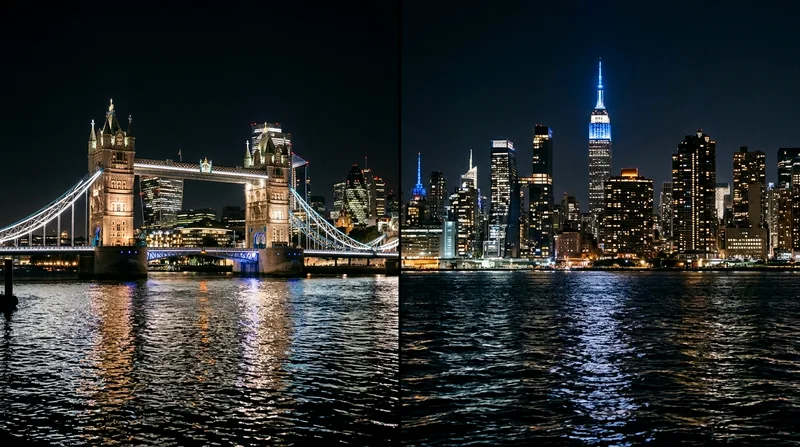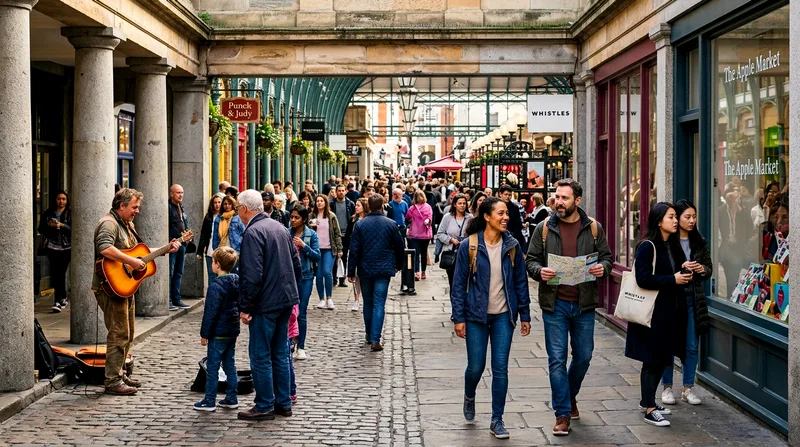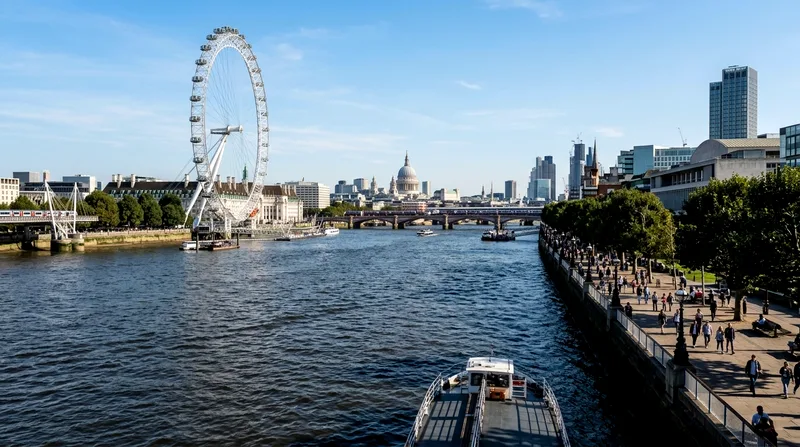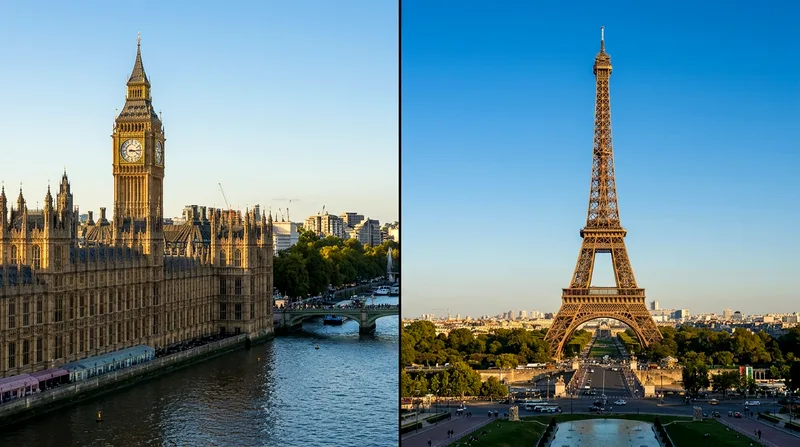
London vs Paris for a first European trip: compare costs, attraction passes, family-friendliness and ease of travel to decide which city to visit first.
London vs Paris at a Glance
Every first-time visitor to Europe eventually asks the same question: London or Paris? Both cities anchor a first trip well, both are under 2.5 hours apart by train, and both can eat a week of your itinerary without you running out of things to do. But they're not interchangeable, and treating them as a coin flip means missing what actually makes each one worth the airfare.
London sprawls. Greater London covers roughly 1,570 square kilometres, and the city you'll actually sightsee in — the zone between Notting Hill and the Tower of London — still takes a good 45 minutes to cross by Tube. Paris, by contrast, is tight. The 20 arrondissements fit inside a ring road (the Périphérique) covering about 105 square kilometres, and most tourist sights sit within a 5-kilometre radius of Notre-Dame. If you measure a city trip in steps per day, Paris will cost you fewer of them.
Character is where the real difference shows. London feels layered and improvised — Georgian terraces next to glass towers, markets wedged under railway arches, a skyline with no single unifying style. Paris was largely rebuilt to a plan in the 1850s and 60s under Baron Haussmann, which is why its boulevards and cream-stone buildings look so consistent. If you want architectural harmony, Paris delivers it on every street corner. If you want texture and contradiction, London does that instead.
City size and geography
The Thames curves through London roughly east-west, but the city's sights aren't neatly arranged along it the way Paris's are along the Seine. You'll zigzag between the South Bank, the West End and the City using the Underground far more than you'll use riverboats. Paris keeps nearly everything — the Louvre, Notre-Dame, the Musée d'Orsay, the Eiffel Tower — within a short walk or two Métro stops of the Seine, which makes it easier to build a walking-based itinerary without much transport planning at all.
Key differences in character
London runs on multiculturalism and informality — you'll hear more languages on one Tube carriage than in most European capitals combined, and nobody dresses up to get a coffee. Paris has a stronger sense of occasion; dining out, dressing reasonably well, and a certain formality in shops and restaurants are still part of the culture. Neither is "better," but if you find French dining etiquette stressful, London's anything-goes attitude will feel like a relief.
Sightseeing Costs and Attraction Passes
On the question of is London or Paris cheaper, the honest answer is: it depends what you spend on. Hotels and restaurant meals in central London tend to run pricier than central Paris, particularly for anything mid-range or better. Paris, though, nickel-and-dimes you more on paid entry — the Louvre, the Eiffel Tower summit and Versailles all charge admission, and those add up fast for a family of four. London's big-hitter museums don't.
For a London paris cost comparison that holds up in practice: expect London to cost more per night of accommodation and per round of drinks, while Paris costs more in cumulative entrance fees if you're a completist about sights. Groceries, transport passes and casual lunches land in a similar range in both cities, so the gap is really about where you choose to spend, not a blanket "London is expensive, Paris is cheap" rule.
London offers more free museums and easier English-language navigation, while Paris offers a more compact, walkable sightseeing core.
London vs Paris comparison: cost, walkability, family appeal and sightseeing
| Factor | London | Paris |
|---|---|---|
| Overall cost level | Pricier hotels and dining | Similar overall, pricier paid entry |
| Free museums | Extensive (British Museum, Tate Modern, National Gallery) | Limited (Louvre, Orsay charge entry) |
| Walkability of sights | Spread out, Tube needed | Compact, walkable core |
| Language barrier | Low (English spoken) | Moderate (French helps) |
| Family appeal | Strong, free indoor options | Strong, more café/adult pace |
| Architecture style | Mixed, layered eras | Uniform Haussmann style |
| Best for | First-timers, museum lovers | Foodies, architecture lovers |
Cost levels are relative and change with season and exchange rates, so compare current prices for flights, hotels and passes before booking.
Free attractions and museums
This is London's strongest card. The British Museum, the National Gallery, Tate Modern, the Natural History Museum and the V&A all offer free general admission — you only pay for special exhibitions. That's five major, world-class museums with zero entry cost, which is unusual even by European standards. Paris has some free options too — many city museums (the Petit Palais, for instance) don't charge for permanent collections — but its two headline draws, the Louvre and the Musée d'Orsay, both charge admission, typically in the mid-teens to low-twenties euros range. If your itinerary is museum-heavy, London will save you real money.
Are sightseeing passes worth it?
London's attraction passes (bundling things like the Tower of London, Westminster Abbey and the London Eye) make sense only if you're hitting four or more paid sights in a short window — otherwise you're paying for inclusions you won't use. Paris Museum Passes work on the same logic but can pay off faster, since so many Paris sights charge entry by default; if you're doing the Louvre, Orsay, Arc de Triomphe and Sainte-Chapelle in a few days, a pass often beats paying individually. In both cities, check current prices and inclusions before you book — passes change their line-ups more often than guidebooks update.
Ease of Travel for First-Timers
If you're nervous about navigating a foreign city for the first time, this category probably decides it for you. London's biggest practical advantage is obvious: English is the default language, every sign and ticket machine is in English, and you won't spend mental energy decoding menus or asking directions. That alone makes London or Paris for first trip a less stressful question for anxious first-time flyers or families worried about getting lost.
Paris isn't hard to navigate, but it does ask a little more of you — restaurant staff and shopkeepers appreciate at least a "Bonjour" and "Merci" before switching to English, and transit signage, while clear, is in French first. None of this is a real barrier; it's more a matter of comfort level. Solo travelers and couples who enjoy a bit of friction might actually prefer Paris for this reason — it feels more like "abroad."
Walkability and public transport
The London Underground is extensive — 11 lines, over 270 stations — but Greater London's size means journeys between attractions often take 30-40 minutes even with good connections. The Paris Métro has more stations packed into a smaller area (around 300 stations across 16 lines), so trips between sights are frequently under 20 minutes. Walking across central Paris end to end takes about two hours; doing the same in London takes considerably longer, closer to four. Both systems use contactless payment now, which removes the old hassle of paper tickets.
Language and navigation
Street navigation in London is straightforward because everything — maps, menus, museum placards — is already in your language. In Paris, Google Maps and a translation app solve 95% of problems, but ordering food or asking a pharmacist for something specific is smoother if you know basic French phrases. Neither city will strand you, but London removes a layer of friction that matters more than people admit on a first trip.
Family-Friendliness Compared
For london vs paris for families, both cities work, but they suit different kid temperaments. London's free museums mean you can duck into the Natural History Museum for an hour, let the kids run off energy near the dinosaur skeletons, and leave without feeling you wasted an expensive ticket if they get bored. That flexibility matters enormously with children under eight. Paris's paid sights ask for more commitment — once you've bought Louvre tickets, there's pressure to stay and "get your money's worth," which can backfire with a tired six-year-old.
Pushchair logistics favour London slightly too: the Underground has more step-free stations than it used to, though still not universal, while several older Paris Métro stations involve stairs with no lift. Buses in both cities are easier for prams than the metro/underground.
Activities for children
London has the Natural History Museum's dinosaur gallery, the Science Museum's hands-on exhibits, the London Dungeon for older kids who like being mildly scared, and the London Eye for an easy, low-effort wow moment. Paris counters with the Jardin d'Acclimatation (a dedicated kids' amusement park in the Bois de Boulogne), the Cité des Sciences, and boat trips on the Seine that double as sightseeing. Honestly, London has more free, drop-in options; Paris has a few standout paid ones that are worth the money if your kids are the right age.
Parks, space and pace
London's royal parks — Hyde Park, Regent's Park, Greenwich Park — are larger and more numerous than anything central Paris offers, and they're genuinely built for running around rather than just strolling. Paris's Jardin du Luxembourg and Jardin des Tuileries are lovely but more formal, with gravel paths and "keep off the grass" conventions in places. If your family trip needs a release valve for pent-up kid energy, London's parks give you more room to let that happen.
Which City Suits Which Traveller
Solo travelers will find London slightly easier logistically — English-speaking hostels, a culture used to solo diners, and markets like Borough Market that are made for grazing alone. Paris, though, has a strong café culture that's arguably even more solo-friendly once you get past any initial hesitation — sitting alone at a Parisian café table with a coffee for an hour is completely normal, not awkward.
Couples tend to gravitate to Paris for the obvious reasons — the Seine at dusk, Montmartre's steep streets, the sheer density of good small restaurants — but London's West End theatre scene and its riverside walks from the Tate Modern to the Tower are a legitimate rival for a romantic weekend.
Senior travellers often prefer London's flatter terrain in the centre and its step-free bus network, versus Paris's cobbled streets and older Métro stations with stairs. If mobility is a concern, London is the gentler city physically, even though it's larger overall.
History buffs, foodies and first-timers
History buffs chasing depth of collection should lean London — the British Museum alone holds artefacts from essentially every ancient civilisation, free of charge. Foodies should lean Paris; the city's food culture, from boulangeries to bistros to the Marché des Enfants Rouges, is built around daily ritual in a way London's food scene, strong as it is, doesn't quite match. Absolute first-timers to Europe with no particular leaning either way should probably pick London first — the language comfort reduces the number of things that can go wrong on your first solo navigation of a foreign transit system.
Verdict: Which to Visit First
Weather is a wash — both cities are temperate, grey more often than not, and best visited April to June or September to October to dodge both winter damp and peak summer crowds. Neither city has a dramatically better climate to tip the scales.
If your priority is minimising stress and maximising free world-class sightseeing, choose London first. The language is yours already, the museums cost nothing to enter, and the parks give kids and tired adults somewhere to decompress. If your priority is compact walkability, architectural consistency and a food culture built into daily life, choose Paris first — you'll cover more sights per day on foot and eat better without trying hard.
For families with young children or anyone mildly anxious about a first solo European trip, London is the safer first pick. For couples and travellers who want the classic postcard version of Europe — grand boulevards, café terraces, a tower you can see from almost everywhere — Paris edges it. Compared with Amsterdam or Dublin, both London and Paris are bigger commitments requiring 4-5 days minimum rather than a long weekend; compared with Rome or Barcelona, London and Paris both win on public transport reliability. Either way, book your Eurostar or flights separately from your accommodation, and treat the first trip as a scouting mission — most travellers who do one end up doing the other within a year or two anyway.
Frequently asked questions
Is London or Paris better for a first trip to Europe?
London tends to suit nervous first-timers better because English removes a layer of friction in navigation, ordering food and asking for help. Paris isn't difficult, but it asks a bit more confidence with basic French phrases and unfamiliar transit signage. If you want the lowest-stress first trip, pick London; if you want a stronger "abroad" feeling, pick Paris.
Which is cheaper to visit, London or Paris?
It depends on your habits. London's hotels and restaurant meals usually cost more, but its major museums are free. Paris has similar grocery and transport costs but charges admission for most headline sights like the Louvre and Eiffel Tower. A museum-heavy trip is cheaper in London; a trip with fewer paid sights and more café time is cheaper in Paris.
Which city is more walkable, London or Paris?
Paris is more walkable because its core sights sit within roughly a 5-kilometre radius and the city covers about 105 square kilometres inside the Périphérique. London's Greater London area covers around 1,570 square kilometres, so even central sightseeing usually requires the Underground between stops.
Which city is better for families with children?
London edges it for families mainly because of free entry to major museums like the Natural History Museum and Science Museum, which removes pressure to "get your money's worth." Its royal parks also give kids more open space to run around than Paris's more formal gardens.
Which city has more free attractions?
London, clearly. The British Museum, National Gallery, Tate Modern, V&A and Natural History Museum all offer free general admission. Paris has some free permanent collections at smaller museums, but its two biggest draws, the Louvre and Musée d'Orsay, both charge entry.