Compare London guided walks by neighbourhood and theme, learn when a tip-based tour beats a paid small-group walk, and book with confidence.
Which London Guided Walking Tour Suits You?
London is one of the few major capitals where walking is genuinely the best way to understand how the city fits together — the City of London's Roman street plan, Westminster's ceremonial axis, the South Bank's industrial-to-cultural reinvention. A good guide connects those layers in a way that a map or an app never quite manages. But "London guided walks" covers an enormous range, from a free two-hour overview starting at Charing Cross to a private eight-person walk through legal London with a Blue Badge Guide costing considerably more.
The decision isn't really about quality — most listed tours with solid review counts on sites like TripAdvisor are competently run. It's about matching three things: your interest level in the subject, how much structure you want, and your physical pace. Someone who wants a broad orientation on day one in London needs something different from someone who has already done the Tower of London and the British Museum and wants a deep get into Clerkenwell's printing history or wartime Fitzrovia.
I'd avoid booking the first walk you see purely because it has the most reviews. A tour with 40,000 reviews is usually a large-group, broad-appeal product — fine for orientation, less good if you want to ask questions or linger. Smaller, specialist operators with a few hundred reviews often give a better experience for a specific interest, even if they're less visible in search results.
First-time visitors and history fans
If this is your first trip to London, a general orientation walk through Westminster or the City in your first 24 hours is genuinely useful — it gives you a mental map before you start ticking off individual sights. History fans should skip the generic walk after day one and move to something theme-specific: Roman London, Tudor execution sites, or the Great Fire route from Pudding Lane to St. Paul's Cathedral. These run two to two-and-a-half hours typically, cover one to two miles, and work best with a guide who specialises rather than a generalist doing six different routes a week.
Families, solo travellers and accessibility needs
Families with children aged eight and up generally do fine on a 90-minute themed walk — Harry Potter filming locations or Horrible Histories-style crime walks hold kids' attention better than architecture-focused routes. Solo travellers are the ideal audience for tip-based group walks: no single-supplement pricing, built-in social contact, low commitment if the guide turns out to be mediocre. For accessibility, ask directly before booking — many routes include cobbles (Shad Thames, parts of the City), steps down to river level, or standing-only stretches at monuments. Blue Badge Guides can usually adapt a private route around specific mobility needs; large fixed-route group tours generally can't.
London Walking Tour Types Compared
Before picking a neighbourhood or theme, decide which format you want. The format affects price, flexibility and how much you'll actually absorb — more than the subject matter does.
Tip-based group walks are the cheapest and most flexible entry point, while private Blue Badge tours offer the most control and cost the most.
London guided walking tour categories compared by group size, duration and cost
| Tour category | Typical duration | Group size | Typical cost | Best for |
|---|---|---|---|---|
| Tip-based group walk | 2-2.5 hours | 15-35 people | Pay-what-you-think (tip) | Budget-conscious, solo, first-timers |
| Paid small-group walk | 1.5-2.5 hours | 8-15 people | Low-to-mid fixed price | Better interaction, specific themes |
| Themed walk (Ripper, food, literary) | 1.5-3 hours | 10-25 people | Low-to-mid fixed price | Focused interest, evening plans |
| Private Blue Badge tour | 2-4 hours, flexible | Your group only | Higher, booked per group | Families, accessibility needs, custom routes |
| Self-guided or audio walk | Flexible | Solo or any size | Low one-off cost or free | Independent pace, early starts |
Figures are typical ranges based on widely published patterns; always check current prices and reviews before booking.
Guided vs self-guided and audio walks
A live guide answers questions, adjusts pace to the group, and points out details you'd walk straight past — a worn step at the Temple Church, a bullet scar on a Fleet Street building. Self-guided walks, including apps like Look Up London's routes or downloadable PDF trails, cost nothing beyond the initial purchase (if any) and let you go at 6am before crowds build or stop for two hours in a pub without feeling rude. The trade-off is obvious: no one to ask "wait, why is that church shaped like that," and no built-in storytelling momentum.
Audio walks sit in between — fixed narration, but you control timing. They suit solo travellers and early risers well. I'd lean self-guided or audio only if you're a confident independent traveller who enjoys reading context beforehand; if you want the social element or you're travelling with people who ask a lot of questions, pay for a live guide.
Group size, duration and pace
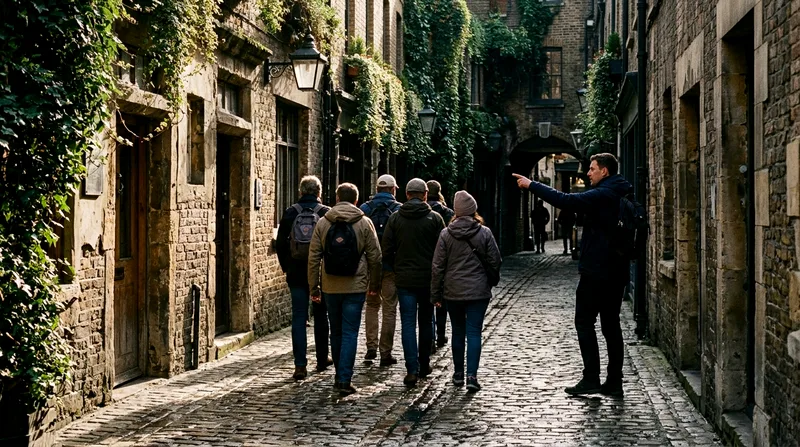
Free, tip-based walks often run large — 20 to 35 people isn't unusual in peak season, especially for the classic Westminster or Jack the Ripper routes. Paid small-group tours typically cap at 8 to 15 people, cost more, but mean you can actually hear the guide without a microphone and ask something mid-route. Private tours run one group only — your party — at a correspondingly higher price, booked per group rather than per person.
Duration ranges from 90 minutes (themed, narrow-focus walks) to three hours (broad historical overviews covering several square miles). Pace matters more than most people expect: a three-hour walk sounds great until you're standing in drizzle at hour two listening to a guide explain guild history. If you or anyone in your group tires easily, pick something under two hours, or a route explicitly billed as a slower, senior-friendly pace.
Best London Walking Tours by Neighbourhood and Theme
London walking tours by neighbourhood work because each area has a distinct character and story arc, rather than being an arbitrary slice of the map.
Westminster, the City and the South Bank
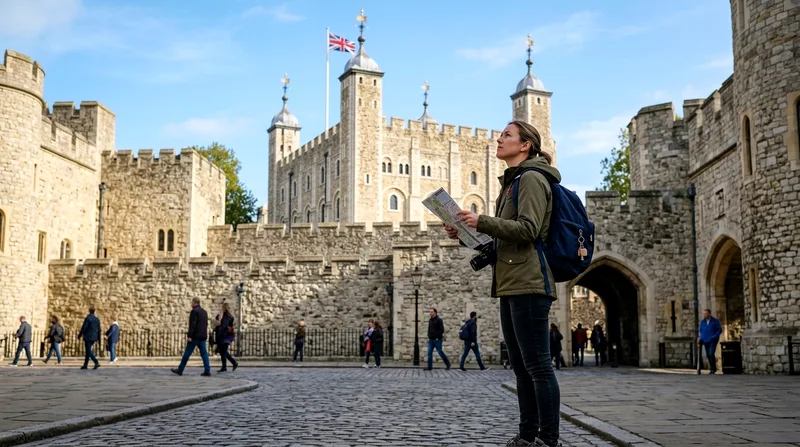
Westminster walks cover Parliament Square, Westminster Abbey, Downing Street and St James's Park — dense with political and royal history, usually under two miles, and a sensible first walk for anyone new to London. The City of London is older and denser still: narrow medieval lanes survive between glass towers, and a good guide threads together Roman walls, the Great Fire, and livery company history around St. Paul's Cathedral in roughly two hours. The South Bank walk, from Westminster Bridge to Tower Bridge, is more visual than historical — river views, Shakespeare's Globe, Borough Market — and suits people who want a relaxed, photogenic route rather than dense fact delivery.
Of the three, I'd rank the City walk highest for genuine substance, Westminster highest for first-timers, and South Bank best paired with lunch at Borough Market rather than booked as a standalone tour.
Themed walks: Jack the Ripper, literary and food
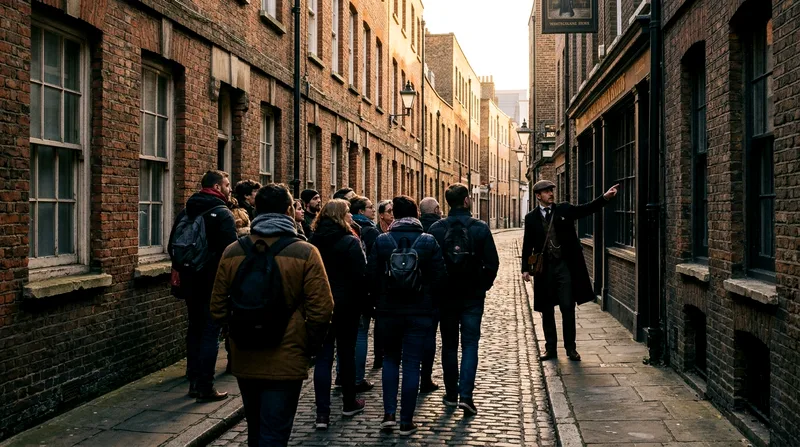
Jack the Ripper tours through Whitechapel are among the most booked themed walks in the city — evening departures, moody East End streets, strong storytelling. They're also hit-or-miss in quality: some guides lean into genuine social history of Victorian poverty, others go for cheap shock value with little historical grounding. Read recent reviews specifically for tone, not just star rating.
Literary walks (Dickens' London, Bloomsbury and the Bloomsbury Group, Sherlock Holmes) suit readers more than casual visitors — skip these if you haven't read the source material, as the jokes and references won't land. Food-themed walks, often through Borough Market, Brick Lane or Chinatown, run two-and-a-half to three hours, include multiple tastings, and function partly as a meal — factor that into your day's eating plans. Operators like London Walks have run themed routes for decades and are a reasonable benchmark for what a well-structured themed tour should include.
Tip-Based vs Paid Small-Group Walks in London
This is the decision most readers are actually weighing, so it deserves a direct answer rather than "it depends."
When a free walking tour is the better choice
A free walking tour in London isn't actually free — guides work on tips, typically expecting somewhere in the range of £10-£15 per person for a good two-hour walk, though you can pay less or more depending on how you rate it. This model works well for broad orientation walks (Westminster, general "Old London" routes) where storytelling matters more than intimate Q&A. It's also genuinely good value if money's tight: you only pay what you think the walk was worth, and there's no pre-booking financial commitment if your plans change. The catch is group size — you're often one of 25-30 people straining to hear over traffic near Trafalgar Square, and the guide can't tailor content to your specific interests.
When paying for a small group is worth it
Pay upfront for a small-group walk when you want a narrow, well-researched theme, a guide you can actually interact with, or a fixed departure time you can plan around without worrying about a huge crowd showing up. Jack the Ripper tours, food walks and most literary routes work better paid and small — the subject matter rewards closer attention than a 30-person crowd allows. If you're a European traveller stacking a short London stopover between, say, Paris and Amsterdam, a paid small-group walk is also just more time-efficient: fixed start time, no guesswork about tip etiquette, generally tighter 90-minute format.
What to Check Before Booking a London Walking Tour
Reviews on TripAdvisor or similar platforms are useful but read them for specifics — mentions of the actual guide's name, comments about pace and group size — rather than trusting the aggregate star rating alone. A 4.5-star average built on 200 reviews tells you less than ten recent reviews that all mention the same strong guide.
Guide credentials and Blue Badge status
Blue Badge Guides are the UK's highest-qualified tourist guides, trained over roughly two years and tested on detailed knowledge of London and Britain more broadly — look for the badge or explicit mention in the listing if deep, accurate history matters to you. Not every good guide is Blue Badge qualified, and plenty of enthusiast-led themed walks (the kind Look Up London built a following on) are run by knowledgeable non-Blue-Badge guides who specialise in one narrow subject. For general sightseeing with heavy historical content, Blue Badge matters more; for a niche theme like street art in Shoreditch, passion and research often matter more than formal credentials.
Inclusions, meeting points and cancellation
Check exactly what's included: food tastings, museum entry (rarely included — the British Museum is free entry anyway, but special exhibitions aren't), transport between stops. Confirm the meeting point precisely — "outside Westminster Underground station, by the exit near the London Eye" beats a vague "Westminster" pin, since several exits exist and groups do get missed. Note the cancellation policy: free tip-based walks have essentially no cancellation risk, while paid tours sometimes charge a fee for cancelling inside 24-48 hours. Build in 15 minutes of buffer to find the meeting point — London Underground exits are not always where you expect.
When to Book Your London Walking Tour
Timing affects both availability and comfort more than most people plan for.
Seasonal demand and weather planning
Summer (June-August) and the weeks around Christmas are the busiest, with larger tip-based groups and faster-filling small-group slots. London rain is frequent but rarely heavy for long — most walks proceed in light rain, and a decent waterproof jacket beats an umbrella in crowded streets. Winter walks, especially evening themed tours like Jack the Ripper, mean early darkness by 4pm from November to February, which actually adds atmosphere to Whitechapel's gaslit lanes but also means dressing warmer than you'd expect for a "short walk."
Booking ahead vs turning up
Free tip-based walks in central areas like Westminster often allow turning up on the day — check the operator's site for the standing meeting point and just show up a few minutes early. Paid small-group and themed walks, especially popular evening ones, fill up a few days ahead in peak season, so book 3-5 days out if you have a fixed date. Private Blue Badge tours need the most lead time — a week or more — since good guides' calendars fill first. Always compare current prices and reviews before you book, since availability and guide assignments shift week to week.
Frequently asked questions
Are free walking tours in London really free?
No — they run on tips. Guides expect roughly £10-£15 per person for a good two-hour walk, though it's genuinely up to you based on quality. There's no obligation to pay a fixed amount, which is the main appeal versus a pre-paid small-group tour.
Should I book a guided or self-guided walk in London?
Choose guided if you want context, storytelling and the chance to ask questions — a live guide will explain details an app can't. Choose self-guided or audio if you prefer flexible timing, want to avoid crowds early in the morning, or are travelling solo and comfortable navigating independently.
What qualifications do London tour guides have?
The top qualification is Blue Badge Guide status, which requires roughly two years of training and rigorous examination on London and British history. Many themed or niche walking tours are led by knowledgeable specialists without this specific badge, which is fine for narrow subjects but worth checking for broad historical routes.
How big are London guided walking tour groups?
Tip-based free walks commonly run 15-35 people in peak season. Paid small-group tours usually cap between 8 and 15. Private tours are just your own party. If hearing the guide clearly matters to you, prioritise the smaller formats.
Do London walking tours run in rain?
Yes, almost always — London rain is typically light and tours proceed as planned. Only genuinely severe weather causes cancellations, and in that case paid operators usually offer a refund or reschedule; check the specific cancellation policy when booking.