Plan your Natural History Museum London visit: how timed-entry booking works, which exhibitions are paid, and the best dinosaur route for families.
Why Visit the Natural History Museum
Walk through the main doors on Cromwell Road and you land straight in Hintze Hall, where a 25.2-metre blue whale skeleton hangs from the ceiling above a crowd of necks craned upward. It replaced the famous plaster diplodocus cast, "Dippy," in 2017, and the move still splits opinion among regulars — some miss Dippy's cartoonish presence, but the whale is the real thing, and that matters when you're explaining extinction and evolution to a seven-year-old. The Natural History Museum London holds around 80 million specimens across its collections, though only a fraction is on public display at any time.
This isn't a museum you breeze through. It's four connected zones — Blue, Green, Red and Orange — spread across a building that opened in 1881 and still shows its age in the best way, with terracotta tiles, carved animal reliefs, and vaulted ceilings that feel more cathedral than exhibition hall. Compare it with the Science Museum next door, which is sleeker and more hands-on, or the V&A a few minutes' walk away, which is design and decorative arts rather than natural science — the Natural History Museum sits apart because of its scale and its specimens, not its interactivity.
Collections and worth seeing highlights
Beyond the whale and the dinosaurs, don't skip the Vault in the Red Zone, home to the Cullinan Diamond replica and a genuine Martian meteorite fragment. The Darwin Centre's Cocoon, also in the Orange Zone, lets you watch scientists working behind glass on actual specimens — less flashy than the dinosaurs, but it's one of the only places in London where you see real research happening in public. The Mammals gallery, with its life-size blue whale model suspended from an earlier era of display, and the Human Biology gallery are often skipped by families racing to the fossils, which is a shame because both take under 15 minutes and add real depth.
Location and getting there
The museum sits on Cromwell Road in South Kensington, directly next to the Science Museum and a short walk from the V&A. South Kensington tube station (Circle, District and Piccadilly lines) is the closest stop, about 8 minutes on foot via a covered subway that keeps you dry in bad weather — useful information if you're visiting in British winter. Buses 14, 49, 70, 74, 345 and 360 also stop nearby. There's no visitor parking on-site, and driving into this part of London means the congestion charge zone, so public transport is genuinely the better option here, not just the eco-friendly one.
Visiting Independently or With a Tour
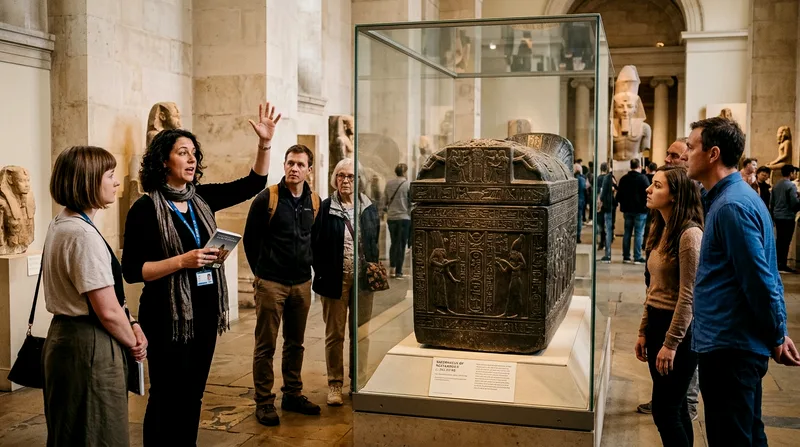
Most visitors do this museum solo, and for good reason — the free galleries are well signposted, the dinosaur route is obvious once you're inside, and audio guides or the museum's own app fill in detail without needing a human guide. That said, a guided tour has real advantages for first-time visitors with limited time or anyone who wants context beyond the information panels, which can be brief given how much ground the museum covers.
Self-guided visit tips
Grab a free map at the entrance — the museum is a maze of connected wings, and even regulars get turned around between the Red and Blue Zones. If you're prioritising dinosaurs, head left from Hintze Hall toward the Blue Zone immediately rather than browsing Hintze Hall exhibits first; the dinosaur gallery gets busy fast and queuing to enter it later in the day is common during half-term weeks. Download the museum's free app before you arrive — it includes a basic wayfinding tool and works without needing to queue for information desk help.
When a guided tour is worth it
A guided or small-group tour makes sense if you're visiting with a large family group, have under two hours total in London and want to see only the highlights efficiently, or if you're a serious enthusiast who wants a specialist's commentary on evolutionary biology or geology rather than wall text. Compare this to the British Museum, where guided tours are almost essential given the sheer sprawl of world cultures on display — the Natural History Museum is more navigable alone, so a tour here is a convenience rather than a necessity. Check current tour options and prices before you book, since group sizes and themes (dinosaurs-only, behind-the-scenes access) vary.
Tickets and Timed-Entry Booking
General admission to the Natural History Museum London is free, which puts it in the same bracket as the British Museum and the V&A rather than paid attractions like the Tower of London or the London Eye. But "free" doesn't mean "walk straight in" — the museum uses a free timed-entry ticket system for general admission, introduced to manage visitor flow, and separately sells tickets for temporary exhibitions that rotate throughout the year.
General admission is always free, but your visit length and crowd exposure depend heavily on timing and route choice.
Natural History Museum London visit options compared
| Visit Type | Cost | Booking Needed | Typical Duration | Best For |
|---|---|---|---|---|
| Permanent galleries (self-guided) | Free | Timed entry slot | 2-4 hours | Most families and first-timers |
| Temporary paid exhibition | Separate paid ticket | Yes, specific slot | 45-60 min extra | Enthusiasts, special interest topics |
| Guided small-group tour | Paid, check current price | Yes, advance booking | 1.5-2 hours | Time-limited visitors, large groups |
| Dinosaur-first family route | Free | Timed entry slot | 2-3 hours | Children aged 4-12 |
| Full-day deep visit | Free plus optional exhibition fee | Timed entry slot | 5-7 hours | Repeat visitors, serious science fans |
Figures are typical planning estimates; always confirm current hours, exhibition tickets and slot availability on the museum's official website before you go.
Free galleries vs paid exhibitions
All permanent galleries — dinosaurs, mammals, human biology, the Vault, Hintze Hall — are free once you have your timed entry slot. Paid exhibitions are temporary shows, often running for several months, covering topics like wildlife photography or specific scientific themes; these require a separate ticket with its own time slot and typically cost in the range of a cinema ticket to a West End matinee, though exact pricing changes with each exhibition. If you're on a tight budget, skip the paid exhibition entirely — the free galleries alone easily fill two to three hours and cover the content most visitors actually come for.
Step-by-step booking process
Booking is straightforward: visit the museum's official website, select your visit date, choose an available entry time slot (these release in advance and popular slots — especially school holiday mornings — fill up first), and complete the free booking with names and an email for confirmation. You'll receive a ticket by email to show on your phone or print. If you want a paid exhibition too, you can usually add it during the same booking flow, selecting a compatible time slot. Always check the official site directly for current opening hours, exhibition availability and any entry requirements, since these do shift with exhibition schedules and seasonal hours.
Best Route for Dinosaur-Mad Kids
If your trip is being planned entirely around a seven-year-old's obsession with Tyrannosaurus rex, build the whole visit around the Blue Zone first, then treat everything else as a bonus. Arrive at your booked entry time, walk through Hintze Hall without lingering too long by the whale (save it for the way out), and go directly into the dinosaur gallery before it fills up.
Dinosaur gallery and fossil highlights
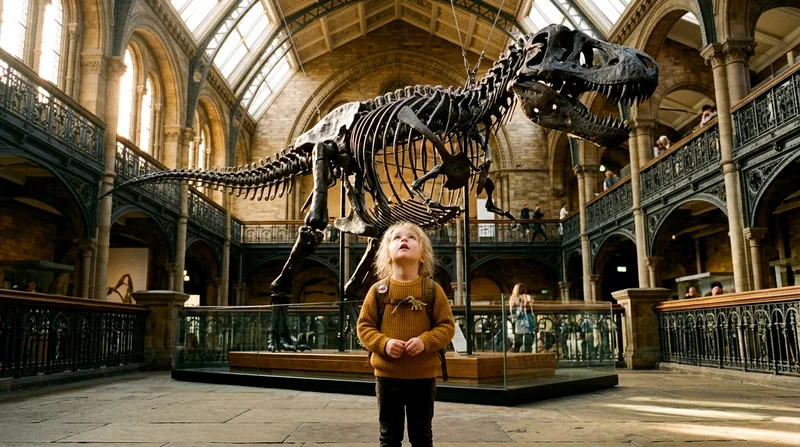
The dinosaur gallery is a raised walkway that takes you past a Triceratops skull, a Stegosaurus skeleton, and the museum's animatronic T. rex, which still draws a genuine gasp from most kids under ten despite being a fixture for decades. The walkway is one-directional and narrow in places, so expect slow shuffling during busy periods — this is the single most congested room in the museum, and mid-morning on weekends or the first days of school holidays can mean standing room only near the T. rex. Fossil highlights continue into the adjacent galleries, including ammonites and early marine reptiles, which are quieter and worth the extra ten minutes if your child's interest extends beyond the big names.
Pacing, breaks and facilities
Budget 45-60 minutes for the dinosaur gallery alone if you're moving at a child's pace with questions and photo stops. There are baby-changing facilities and accessible toilets in multiple zones, and the museum is step-free throughout with lifts between floors — useful for buggies as well as wheelchair users. The Green Zone café and the museum's central courtyard café both offer kid-friendly food, though prices run high for what you get, comparable to any central London tourist-area café; packing snacks is reasonable and allowed in most areas. Plan one deliberate break after the dinosaurs — meltdowns are common once the initial excitement fades and blood sugar drops.
Best Time to Visit
Weekday mornings, particularly Tuesday through Thursday outside of UK school holidays, are consistently the quietest. The museum tends to open mid-morning and the first hour after opening is reliably calmer than any point after midday. Weekends and school holiday periods bring noticeably larger crowds, especially around the dinosaur gallery and Hintze Hall.
Avoiding queues and crowds
Even with a timed-entry ticket, there's often a security line outside on Cromwell Road before you reach the ticket check — arriving at the very start of your slot, rather than mid-slot, usually means a shorter outdoor wait. Avoid the first week of summer holidays and the days immediately around Christmas and New Year, when the museum is at its busiest and the dinosaur gallery queue can stretch well beyond the gallery entrance itself. Rain also pushes more visitors indoors across South Kensington's museums generally, so a wet weekday will be busier than a dry one.
How long to allow
For a focused dinosaur-first family visit, two to three hours is realistic. If you want to also see the Vault, the Cocoon, and the Mammals gallery properly, allow four hours and consider a lunch break roughly halfway through. Enthusiasts covering the whole museum in depth, including temporary exhibitions, can easily spend a full day — more time than most people expect from what looks, from the Cromwell Road façade, like a single building.
Nearby South Kensington Add-Ons
South Kensington packs three major museums within a ten-minute walk of each other, which makes it one of the most efficient museum clusters in London — arguably more convenient than the Louvre-to-Orsay walk in Paris, since here all three are free to enter and connected by the same pedestrian underpass from the tube station.
Science Museum and V&A
The Science Museum sits directly next door on Exhibition Road and suits kids who liked the Natural History Museum's hands-on Cocoon area — it leans further into interactive exhibits, including a flight gallery and a hands-on Wonderlab (small paid entry for that specific zone). The Victoria and Albert Museum is a five-minute walk and covers design, fashion and decorative arts; it's a better fit for teenagers or adults than young children, and pairing it with the Natural History Museum in one day is ambitious unless you're prepared to move quickly through both.
Exhibition Road and Hyde Park
Exhibition Road itself, the pedestrian-friendly street linking the three museums, has cafés and a seasonal ice rink in winter outside the Natural History Museum. Hyde Park is roughly a 15-minute walk north and makes a good decompression stop after a packed museum morning — the Diana Memorial Playground near Kensington Gardens is a strong follow-up for families with younger children who need to burn off energy before heading back to a hotel.
Frequently asked questions
Is entry to the Natural History Museum London free?
Yes, general admission to all permanent galleries is free, including the dinosaur gallery, Hintze Hall and the Vault. Only temporary special exhibitions, which rotate a few times a year, charge a separate admission fee. You'll still need a free timed-entry ticket booked in advance to access the main galleries.
Do I need to pre-book tickets for the Natural History Museum?
For general admission, yes — the museum operates a free timed-entry system, and turning up without a booking can mean a long wait or being told to come back later, especially on weekends and school holidays. Booking takes a few minutes on the official museum website and tickets arrive by email.
How long do you need at the Natural History Museum?
Plan for two to three hours if you're focused mainly on the dinosaur gallery and Hintze Hall. Four hours lets you add the Vault, Cocoon and Mammals gallery at a relaxed pace. A full day suits anyone wanting to see most of the museum, including a paid temporary exhibition.
How do I avoid queues at the Natural History Museum?
Book the earliest available timed-entry slot, arrive right at the start of it, and visit on a weekday outside UK school holidays if possible. The dinosaur gallery itself gets congested faster than any other room, so head there directly from Hintze Hall rather than browsing other exhibits first.
Where are the dinosaurs in the Natural History Museum?
The dinosaur gallery is in the Blue Zone, reached by turning left shortly after entering through Hintze Hall. It's a raised, one-directional walkway, so once you're in you'll move through at the pace of the crowd — arriving early in your entry slot helps avoid the worst congestion near the animatronic T. rex.